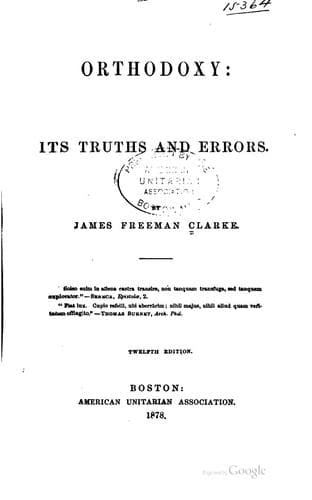
Orthodoxy: Its Truths And ErrorsClarke, James Freeman
Religion
Orthodoxy: Its Truths And Errors
Clarke, James Freeman
Unitarianism
When he was on trial before Caiaphas and before Pilate, they were on
trial, and not he. When they sentenced him, they condemned themselves.
During the whole of those dark hours, when Christ was buffeted, spit upon,
crowned with thorns, to the eyes of angels he was seen to be sitting on
the throne of his glory. Caiaphas and the Jewish priests, Pontius Pilate
and the Roman soldiers, Judas Iscariot, the Jewish people, each in turn
received their sentence, and passed to the left hand. And so ever since,
whenever any great opportunity has been given to the world to decide
between right and wrong, the world has pronounced judgment on itself; has
gone to the right hand with the sheep, or to the left hand with the goats.
When Paul offered Christianity to the Jews, and they rejected it, he said
“it was necessary that the word of God should first have been spoken to
you; but seeing you put it from you, and judge yourselves unworthy of
eternal life, lo, we turn to the Gentiles.” So it always is. God does not
judge us, nor Christ; but we judge ourselves. For this reason Jesus says,
“If any man hear me, and believe not, I judge him not; for I came not to
judge the world.” And again he says, “The word which I have spoken, the
same shall judge him at the last day.” And yet again, “This is the
judgment, that light has come into the world, and that men have chosen
darkness rather than light, because their deeds are evil.”
The account of judgment (in the 25th chapter of Matthew) at Christ’s
coming we considered in the last chapter. It will, however, bear a little
further examination. There are _three_ different judgments indicated in
the three parables of the virgins, the talents, and the sheep and goats.
The first is the judgment of opportunity, the second of work, the third of
knowledge. In the first and second we judge ourselves, in the last we are
judged. These two occur in time, the other in eternity. The first two are
the judgments which take place at Christ’s coming here; the third is the
judgment of “the last day.” The first takes place whenever we are “called”
by a new opportunity; the second comes in all retribution; the third by
the inward revelation of God’s truth, showing men what they are, and what
God is. The wise and foolish virgins represent those _who are invited to
receive Christianity_; the servants with the talents, believers who have
received it in different degrees; and the nations (heathen, τὰ ἔθνη)(58)
those (in Christendom or outside of it) to whom Christianity has never
come.
§ 9. The Doctrine of Annihilation.
Public-domain text, read in full here on John Shaqi.
Reviews
Reviews
No reviews yet
Be the first to share your thoughts on this work.
Elsewhere in the archive
Join the Discussion
Join the discussion
Sign in to leave a comment or review.
Sign InorCreate an account