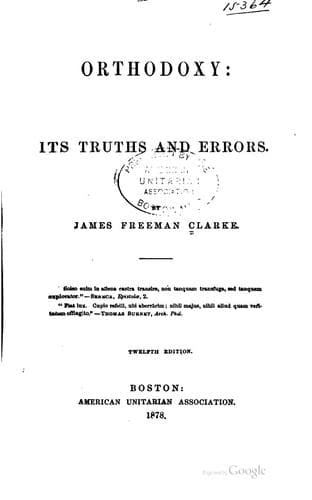
Orthodoxy: Its Truths And ErrorsClarke, James Freeman
Religion
Orthodoxy: Its Truths And Errors
Clarke, James Freeman
Unitarianism
Such was the original Church, as described in the Acts and Epistles. It
sprang up because it was wanted, and Christ foresaw that it would be. It
was founded not on an arbitrary command, but on the needs of human nature.
Man is not a solitary, but a social being. He needs society in his labors
and in his joys; society in study, society in relaxation. Even in the
highest act of his life,—in the act of prayer, in communion with God; in
that act, called by an ancient Platonist “the flight of one alone to the
only One,”—even then he cannot be alone. In the union of man with man in
any natural and true relation, his thought becomes more clear, his will
more firm, his devotion more profound, his affections more enlarged. The
broader and deeper the basis of the union, the more it blesses and helps
him. A friendship based upon the knowledge and love of the same God, what
can be better for us than this?
Thus we see that the apostolic Church was a home for Christ’s family
(Matt. 12:49); a school for his disciples; a fraternity of brethren. For
discipline, it had officers, but no clergy, nor priesthood, for all were
priests, and all took part in the services. (1 Peter 2:5; Rom. 1:6; 1 Cor.
14:26.) Its only creed was a belief in Jesus as the Christ, the Son of
God. (Acts 8:37; 16:31. 1 John 4:15; 5:5, 10. Rom. 10:9.) The unity of the
Church was not the unity of opinion, nor the unity of ceremonies, but the
bond of the Spirit (Eph. 4:3), and the central unities of faith, not of
doctrine (Eph. 4:5.) The object of the Church service was not merely to
partake the Lord’s Supper together, nor to maintain public worship, nor to
defend and propagate a creed, nor to call men into an outward
organization, nor to gather pious people together, and keep them safe as
in an ark, but to _do good_ and _get good_—to grow up in all things into
Him who is the Head. And the condition of membership was to wish to be
saved from sin, and to have faith in Christ that he could save them; it
was to hunger and thirst after righteousness.
§ 8. The Actual Church, or the Church as it is.
Public-domain text, read in full here on John Shaqi.
Reviews
Reviews
No reviews yet
Be the first to share your thoughts on this work.
Elsewhere in the archive
Join the Discussion
Join the discussion
Sign in to leave a comment or review.
Sign InorCreate an account