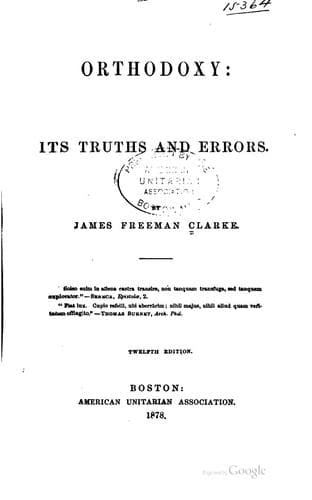
Orthodoxy: Its Truths And ErrorsClarke, James Freeman
Religion
Orthodoxy: Its Truths And Errors
Clarke, James Freeman
Unitarianism
Now, if we turn from the Church as it was to the Church as it is,—from the
apostolic Church to those around us,—we see a difference. Instead of the
freedom and union which were in the early Church, we find in the Roman
Catholic communion union, but no freedom; in the Protestant Churches
freedom, but no union. In both we find the Church built on the ministry,
instead of the ministry on the Church; the priests everything, the people
nothing; fixed forms, instead of a free movement; dead creeds, instead of
a living faith. The spirit of worldliness has entered the churches, and
they try to serve God and Mammon; God on Sunday, and Mammon on the week
days. The members of the churches are more devout and more religious, but
not more moral or more humane, than many who are out of their body. And
because they do not love man whom they have seen, they find it hard to
love God, whom they have not seen. Their want of humanity destroys their
piety.
A vast amount of good is done by the churches, even in their present
state; but when we think of what they might do, it seems nothing. Yet it
is _not_ nothing. Could we know the good done by the mere sound of the
church bells on Sunday, by the quiet assembling of peaceful multitudes in
their different churches; could we measure the amount of awe and reverence
which falls over every mind, restraining the reckless, checking many a
half-formed purpose of evil, rousing purer associations and memories,
calling up reminiscences of innocent childhood in the depraved heart of
man; could we know how many souls are roused to a better life, made to
realize their immortal nature, reminded of a judgment to come; could we
see how many souls, on every Sabbath, in our thousands of churches, are
turned from sin to God, how many sorrowing hearts are consoled by the
sweet promises of the gospel; could we see, as God sees and the angels
see, all this,—we should feel that the churches, in their greatest
feebleness, are yet the instruments of an incalculable good. But when we
look at what _is_ to be done, what _ought_ to be done, what _could_ be
done by them, their present state seems most forlorn.
It is one of the most difficult of our duties not to despise an imperfect
good, and yet not to be satisfied with it.
Public-domain text, read in full here on John Shaqi.
Reviews
Reviews
No reviews yet
Be the first to share your thoughts on this work.
Elsewhere in the archive
Join the Discussion
Join the discussion
Sign in to leave a comment or review.
Sign InorCreate an account