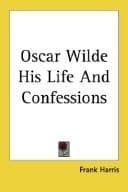
Oscar Wilde, His Life and Confessions — Volume 1Harris, Frank
History
Oscar Wilde, His Life and Confessions — Volume 1
Harris, Frank
Authors, Irish -- 19th century -- Biography; Wilde, Oscar, 1854-1900
It was at our first lunch, I think, that he told me he had been asked by
Harper's to write a book of one hundred thousand words and offered a large sum
for it--I think some five thousand dollars--in advance. He wrote to them
gravely that there were not one hundred thousand words in English, so he could
not undertake the work, and laughed merrily like a child at the cheeky reproof.
"I have sent their letters and my reply to the press," he added, and laughed
again, while probing me with inquisitive eyes: how far did I understand the need
of self-advertisement?
About this time an impromptu of his moved the town to laughter. At some
dinner party it appeared the ladies sat a little too long; Oscar wanted to
smoke. Suddenly the hostess drew his attention to a lamp the shade of which
was smouldering.
"Please put it out, Mr. Wilde," she said, "it's smoking."
Oscar turned to do as he was told with the remark:
"Happy lamp!"
The delightful impertinence had an extraordinary success.
Early in our friendship I was fain to see that the love of the uncommon, his
paradoxes and epigrams were natural to him, sprang immediately from his taste
and temperament. Perhaps it would be well to define once for all his attitude
towards life with more scope and particularity than I have hitherto done.
It is often assumed that he had no clear and coherent view of life, no belief,
no faith to guide his vagrant footsteps; but such an opinion does him injustice.
He had his own philosophy, and held to it for long years with astonishing
tenacity. His attitude towards life can best be seen if he is held up against
Goethe. He took the artist's view of life which Goethe was the first to state
and indeed in youth had overstated with an astonishing persuasiveness: "the
beautiful is more than the good," said Goethe; "for it includes the good."
It seemed to Oscar, as it had seemed to young Goethe, that "the extraordinary
alone survives"; the extraordinary whether good or bad; he therefore sought
after the extraordinary, and naturally enough often fell into the extravagant.
But how stimulating it was in London, where sordid platitudes drip and drizzle
all day long, to hear someone talking brilliant paradoxes.
Goethe did not linger long in the halfway house of unbelief; the murderer may
win notoriety as easily as the martyr, but his memory will not remain. "The
fashion of this world passeth away," said Goethe, "I would fain occupy myself
with that which endures." Midway in life Goethe accepted Kant's moral
imperative and restated his creed: "A man must resolve to live," he said,
"for the Good, and Beautiful, and for the Common Weal."
Oscar did not push his thought so far: the transcendental was not his field.
Public-domain text, read in full here on John Shaqi.
Reviews
Reviews
No reviews yet
Be the first to share your thoughts on this work.
Join the Discussion
Join the discussion
Sign in to leave a comment or review.
Sign InorCreate an account