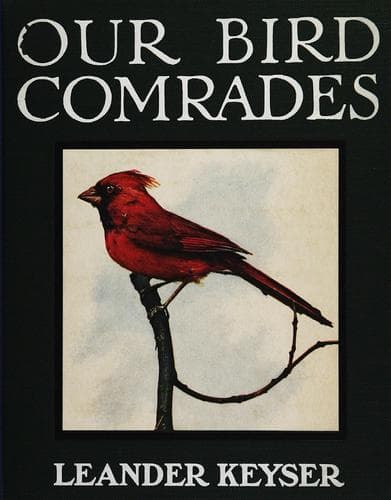
Our Bird ComradesKeyser, Leander S. (Leander Sylvester)
History
Our Bird Comrades
Keyser, Leander S. (Leander Sylvester)
Birds
After some difficulty, I fixed my glass upon a number of little
sparrows about the size of the chippies. They bore a close resemblance
to that species too, save that the crown-piece and the general tone of
the back were decidedly darker, while the under parts were a good deal
whiter. The clear, ash-colored cervical interval between the crown and
the back and the distinct brown loral and auricular space told me
plainly who the little charmers were. Not at the moment, however, for
the birds were new to me, and I had to wait until I could consult my
manual before I was able to decide that they were the clay-colored
sparrows.
Their song is an odd vocal performance--a low, croaking trill, preceded
by a few longer notes, all delivered in the same key. It is, in fact,
a contralto solo divided into brief stanzas, and easily might be
mistaken for the grating buzz of an insect, especially if heard at a
distance of a few rods. It possesses little or no musical quality, and
is perhaps the most curious style of bird minstrelsy with which I am
acquainted. In comparison the chippie's trill sounds loud and clear
and bell-like, with a distinctly melodious quality of tone. The song
of the little clay-colored sparrow is also marked by a kind of drawl,
giving one the impression that the bird is just a little too lazy to
exert himself; yet when you get him in the field of your glass and see
him throw back his head, expand his throat and chest, and open his
mandibles as wide as he can, you quickly decide that he is not the
apathetic creature his desultory song would lead you to infer. It
really is laughable, and almost pathetic, too, to note how much energy
he expends in the production of his poor little aria.
Indeed, not in the least sluggish is the blood flowing in the veins of
_Spizella pallida_, for he is a vivacious little body, flitting about
actively in the hedges and bushes, and sometimes mounting into the
trees, chanting his little alto strain all the while, as if his life
depended upon it. He is one of the comparatively few birds who is
lavish of his song in migration.
Unlike the familiar chippie, he does not usually find a perch in plain
sight, from which to rehearse his song, but keeps himself well hidden
in the bushes or trees, darting into a hiding place as soon as he
thinks himself discovered. The shy little imp prefers to put a screen
of foliage or twigs between himself and the observer. Might his motto
be, "Little birds should be heard and not seen"? I had quite a time
making sure of him, but, as a pleasant compensation, when his identity
was once settled, I could not well have mistaken him for another
species, for he is a bird of real distinction.
Public-domain text, read in full here on John Shaqi.
Reviews
Reviews
No reviews yet
Be the first to share your thoughts on this work.
Join the Discussion
Join the discussion
Sign in to leave a comment or review.
Sign InorCreate an account