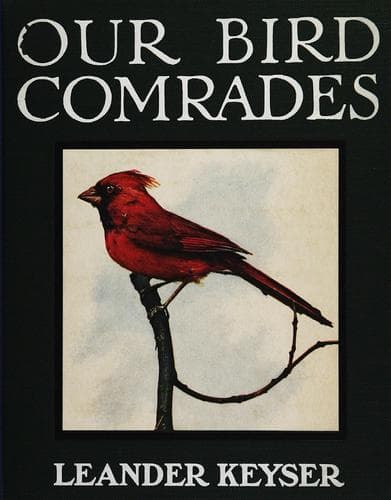
Our Bird ComradesKeyser, Leander S. (Leander Sylvester)
History
Our Bird Comrades
Keyser, Leander S. (Leander Sylvester)
Birds
My study of the clay-colored sparrows was restricted to their habits in
migration, at which time they move about in more or less compact little
flocks, gathering seeds and chanting their monotonous trills. While I
first found these sparrows near Peabody, they were also fairly common,
a few days later, in northeastern Kansas, about a mile back from the
Missouri River, where their low alto strains formed a kind of gray
background for the high-pitched trills of the Harris sparrows and the
loud pipings of the cardinals. Quaint as our little contralto's solos
are, they have a distinct fascination for me, and now that I no longer
live in the Sunflower state, I miss them sorely when the springtime
comes.
These sparrows do not, I believe, breed in Kansas, but are known to
establish their households in the northern part of Illinois, central
and northern Iowa, the Red River region in Minnesota, the country
drained by the upper Missouri River and its tributaries, Manitoba as
far north as the Saskatchewan River, and the plains and bases of the
foothills of eastern Colorado. Their nests are built on the ground or
in low bushes, and from three to five eggs, of a greenish-blue tint,
flecked with cinnamon-brown, are deposited. They spend the winters in
southern Texas and still farther south. Only "accidentally," as the
word goes, are they known in the eastern part of the United States, and
for that reason little has yet been written about them in popular books
on birds. The time will come, no doubt, when they will have a
well-recognized place in bird literature, just as the chippie, the
vesper sparrow, and the song sparrow have to-day.
In bird study it is never safe to take too much for granted. One must
be constantly on the alert, and, more than that, one must be able to
make fine distinctions with both the ear and the eye. Here is a case
in point. For many days, while strolling about in quest of bird lore,
I heard a quaint little song in the bushy clumps, and that, too, in
some of the most out-of-the-way places. "It is nothing but the house
wren," I muttered to myself, I know not how often. "It isn't worth
while to look for it when there are new birds to be found. Still, it's
singular," I continued, "that the house wren should dwell in such
secluded places. It would seem that his name is a misnomer--at least,
in a good many instances." Several times I stopped to listen more
intently to the rolling ditty. "There's something odd about that
wren's song," I repeated. "Does the house wren always close its song
with the rising inflection, as if it were asking a question?"
Public-domain text, read in full here on John Shaqi.
Reviews
Reviews
No reviews yet
Be the first to share your thoughts on this work.
Join the Discussion
Join the discussion
Sign in to leave a comment or review.
Sign InorCreate an account