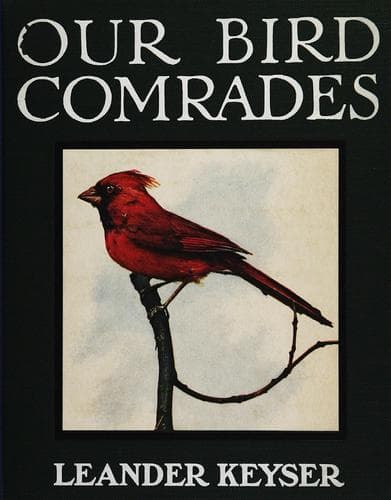
Our Bird ComradesKeyser, Leander S. (Leander Sylvester)
History
Our Bird Comrades
Keyser, Leander S. (Leander Sylvester)
Birds
Belonging to the same subfamily is the orange-crowned warbler. It has
not so marked a preference for trees as its little relatives just
mentioned, but likes, so far as my observation goes, to flit about in
thickets, where it remains in hiding until driven from its covert or
drawn forth by curiosity. Only for a moment does it appear in sight,
then plunges into another covert. You will note that its eye-ring is
yellow, and that its under parts are neither bright yellow, like the
Nashville's, nor white, like the Tennessee's, but greenish yellow
obscurely streaked on the chest. I have never heard the song of the
orange-crown.
There are a number of shy warblers that are especially partial to wild,
unfrequented parts of the woods, where they are seldom disturbed by human
intruders. In Kansas I found them in the deep, densely wooded ravines
running back from the Missouri River and its tributary valleys. Although
these feathered recluses are rarely molested by man, they seem to know
enough about his character to look upon him with a suspicious eye when he
ventures into their sylvan domain. Hence they are hard to study, and it
is not often that their deftly hidden nests can be found.
One of the most delightful of these hermits is the Kentucky warbler. A
brilliant little bird he is, with his golden under parts and superciliary
line, his black patch on the cheek just below the eye, his black cap, and
his coat of iridescent olive green. You will not mistake him for the
Maryland yellow-throat, which also wears a black patch on the side of his
head; but this patch lies over the eye and includes it, and its upper
border is white, while this bird lacks the yellow and curved superciliary
band. Besides, the yellow-throat is not a woodland but a marsh bird.
The Kentucky warbler is attractive in many ways. An industrious
minstrel, his voice is strong and full for so small a bird, and until you
learn to know his tune well, you may mistake it for that of the cardinal.
But, as a piper, he lacks the versatility of the cardinal, who carries a
number of music sheets in his repertory, while the little Kentuckian
confines his lyrical efforts principally to one strain. Sometimes he
delivers his intermittent aria from a low bush or even from the ground,
but his favorite song-perches are the branches of saplings and trees just
below the zone of foliage. Here, in the shadows, you may be compelled to
look for him for some time before you espy his trig little form, and even
then you are likely to see him because he flits to another perch rather
than because you first catch the glint of his colors. Whether he means
it or not, he is something of a ventriloquist, for which reason you will
often look for him in many places before seeing him.
Public-domain text, read in full here on John Shaqi.
Reviews
Reviews
No reviews yet
Be the first to share your thoughts on this work.
Join the Discussion
Join the discussion
Sign in to leave a comment or review.
Sign InorCreate an account