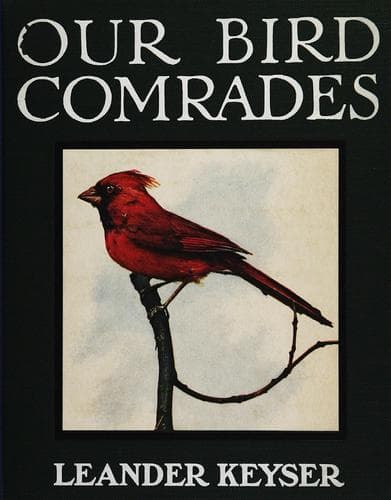
Our Bird ComradesKeyser, Leander S. (Leander Sylvester)
History
Our Bird Comrades
Keyser, Leander S. (Leander Sylvester)
Birds
What an enigma the Tennessee warbler for a long time remained to me!
Never still for a moment, yet so indistinctly marked that at a distance
it looks like a dozen other birds one might name--a veritable feathered
rebus. But finally I fixed its place in the avian schedule with the help
of my field glass--white under parts, slightly tinged with yellow, back
and rump olive green, top and sides of head delicate bluish-ash; no
eye-ring, no wing-bars. There is no other warbler marked quite like
that. And yet its song is its most conspicuous mark, so to speak, for it
is a loud, shrill, and very rapidly repeated run, which might be spelled
out in this way: "Chippy, chippy, chippy, chippity-chippity-chippity."
The whole song is emitted at a galloping pace, giving you the impression
that the bird is in a desperate hurry. Important business on hand, no
doubt! Yes, there is a worm or a nit on the under side of that leaf, and
he must nab it now or never! With such pressing business matters on
hand, he has no time for regaling you with "linked sweetness long drawn
out."
Still, he sometimes does prolong his ditty, giving it a saucy,
challenging air. No other warbler sings so loudly. His voice is as
shrill and penetrating as that of the indigo bird, though the song is
quite different in technique.
[Illustration: Yellow Warbler]
Another feathered conundrum was the Nashville warbler, whose back and
head are colored like those of the Tennessee, but whose under parts are
bright yellow, instead of white or white only slightly washed with
yellow; and, besides, sharp peering through your glass will reveal a
distinct white ring encircling the eye. The bird in the hand would also
show a dainty chestnut patch on the crown, but this mark is seldom seen
while it is flitting about in the leafy trees. The songs of the
Nashville and the Tennessee are somewhat similar, but not the same, the
Tennessee's being louder, shriller, and more sharply accentuated, while
his cousin's is more liquid and musical and far less sibilant. My notes
represent the Nashville's song phonetically as follows: "Swee, swee,
swee, ah-wit-ah-wit-ah-wit," delivered rapidly in a high key and with not
a little energy and emphasis. When my notes were made the little lyrist
was putting his best foot forward, and was not high in the trees, so that
I heard him distinctly. The Tennessee warblers were also singing near at
hand, giving me a good opportunity to compare the arias of the two
species.
Public-domain text, read in full here on John Shaqi.
Reviews
Reviews
No reviews yet
Be the first to share your thoughts on this work.
Join the Discussion
Join the discussion
Sign in to leave a comment or review.
Sign InorCreate an account