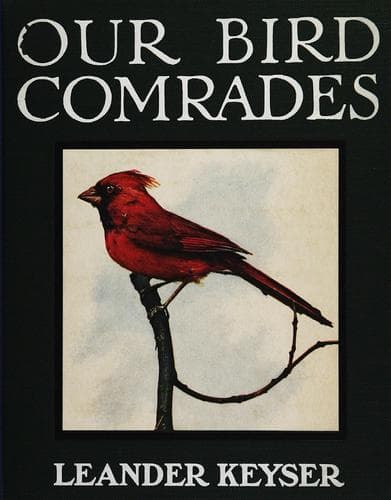
Our Bird ComradesKeyser, Leander S. (Leander Sylvester)
History
Our Bird Comrades
Keyser, Leander S. (Leander Sylvester)
Birds
The redstart has some interesting ways. One of them is his habit of
spreading out his wings and tail as he perches or flits about in the
trees, as if he were anxious to display the fiery trimmings that so
elegantly set off his little black suit. Blood will tell, for I have
seen the young redstarts imitating their parents by spreading out their
odd, croppy tails in a comical way.
[Illustration: Chickadee]
How early in life young birds are taught some of the lessons that are
needful for their own safety! One day I heard a young redstart chirping
for his dinner. I quietly thrust my head into the thicket, and soon
espied the birdkin perched on a twig only about a rod away. He either
did not see me, or else decided that I was not a bugaboo. A few minutes
later the mother darted into the enclosure and fed her baby. She was too
much absorbed in her duties to notice me until the repast was over; then
she suddenly caught sight of her unwelcome caller. She stood transfixed
with astonishment for one breathless moment, then uttered a piercing cry
of alarm that sent the little one dashing away like a streak of
lightning. Plainly the youngster understood his mamma's signal, for
until she uttered it he had sat perfectly quiet and unconcerned, perhaps
not even aware of my presence. Birds are taught the language of fear at
a tender age. Of course they learn it so readily because there is a
basis of timidity in their natures, implanted by heredity.
CHICKADEE WAYS*
*Reprinted by permission, from "Our Animal Friends," New York.
In a somewhat casual way, and without going into their natural history,
the last two chapters have indicated the method of making an
acquaintance with new species and of studying the habits of a few wild
birds. A few chapters will now be devoted to a fuller study of a
number of interesting birds. Not that I expect to write their complete
life histories, which, indeed, would not be necessary; but that I may
give you some idea of the large amount of knowledge that can be gained
of one species. If this were multiplied by the knowledge procurable
from the study of all the members of the feathered brotherhood, think
what an education the whole would give one. Let us begin with the
familiar little tomtit.
In his valuable manual, "Birds of Eastern North America," Dr. Frank M.
Chapman calls the little black-capped chickadee an "animated bunch of
black and white feathers." That is certainly a graphic and correct way
of putting it, for no bird is more active and alert than this little
major with the black skull cap and ashy-blue coat. Everybody knows
him, I take it, but if any more points are needed for his
identification, you must look for a little bird which, in addition to
his cap of glossy black, wears a bib of the same color, buckled up
close to his chin, with a wedge of white inserted on each side of his
neck between the black of his throat and crown to the corner of his
mouth.
Public-domain text, read in full here on John Shaqi.
Reviews
Reviews
No reviews yet
Be the first to share your thoughts on this work.
Join the Discussion
Join the discussion
Sign in to leave a comment or review.
Sign InorCreate an account