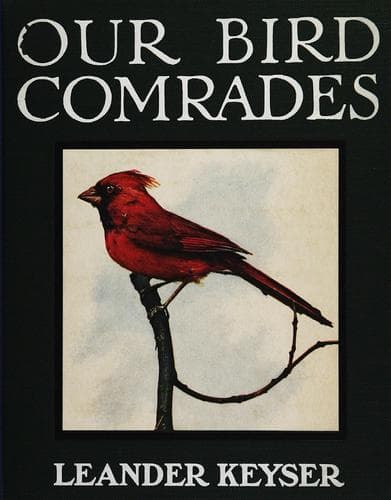
Our Bird ComradesKeyser, Leander S. (Leander Sylvester)
History
Our Bird Comrades
Keyser, Leander S. (Leander Sylvester)
Birds
If all birds were as sociably disposed as the little tomtit--for that
is also one of his names--bird study would be a delight, and almost a
sinecure. Trustful and fearless, he often comes within a few feet of
you, and fixes you with his keen little eyes, which dart out
innumerable interrogation points. Sometimes he calls his own name in a
saucy way, "Chick-a-dee-dee, chick-a-dee-dee," which, being
interpreted, means, "What is your business here, sir? Aren't you out
of your proper latitude?" Occasionally he will grow terribly excited
over your presence--or at least pretend to--scolding and shaming you
until you feel yourself a real interloper; at other times he will
salute you in the most affable way, as if bidding you welcome to his
haunts and inviting you to come often and make yourself at home. What
a pity it is he cannot talk, and let us know what he really thinks of
us and of the world in general! Dr. Chapman says that on two occasions
chickadees have flown down and perched on his hand, giving him the
feeling that he was being taken into their confidence.
Watch Master Tomtit as he performs some of his acrobatic feats, putting
the tilters and tumblers in the human circus to the blush. He often
hangs back downward from a slender twig or even a leaf, and daintily
picks the nits that have ensconced themselves in the buds or foliage.
Let his flexile perch sway in the wind as it will, he is safe, for if
the twig should break or his hold should slip, which seldom occurs, he
can recover himself at once by spreading his nimble wings, wheeling
about, and alighting on a perch below. Ah, yes! the tomtit is the
embodiment and poetry of nimbleness.
But he is more than a mere feathered gentleman; he is an extremely
useful citizen. Prof. E. D. Sanderson published a valuable article in
"The Auk" for April 1898, in which he proved that this bird serves a
most useful purpose as an insecticide. He examined the craws of
twenty-eight chickadees, nineteen of them secured in the winter and
nine in the spring. During the winter 70.7 per cent of the food found
in these stomachs was animal, while in the spring no vegetable matter
was found at all, the birds subsisting entirely on insects and their
eggs and larvae. By far the larger part of the insects thus destroyed
were of the noxious species that bore into the bark and wood of the
trees or sting the fruit. An orchard in which several chickadees had
taken up their abode one winter and spring was so well cleared of
canker worms that an excellent yield of fruit was grown, whereas the
trees of other orchards in the neighborhood were largely defoliated by
the destructive worms, and there was no yield of fruit.
Public-domain text, read in full here on John Shaqi.
Reviews
Reviews
No reviews yet
Be the first to share your thoughts on this work.
Join the Discussion
Join the discussion
Sign in to leave a comment or review.
Sign InorCreate an account