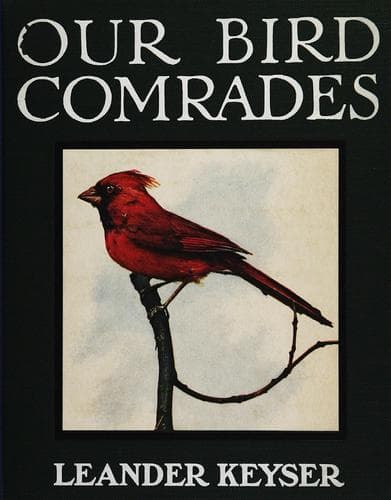
Our Bird ComradesKeyser, Leander S. (Leander Sylvester)
History
Our Bird Comrades
Keyser, Leander S. (Leander Sylvester)
Birds
In Colorado there is little of a migratory movement even up and down
the mountains among these interesting birdlets. In the winter a few
descend from the heights and dwell on the plains, where the weather is
not so rigorous. On the approach of spring they again hie up into the
mountains, spending the summer there and rearing their pretty bairns.
However, the majority of them remain in the mountains all winter,
braving the bitterest and fiercest storms, often at an altitude of
8,000 feet. Their breeding range is from 6,000 to 10,000 feet, the
latter elevation being only a little below the timber line.
In spite of his unique and interesting habits, the poets have scarcely
begun to chant the praises of the American nuthatch. One of the best
tributes I have been able to find is from the pen of Edith Thomas, who
apostrophizes our bird in this way:
"Shrewd little haunter of woods all gray,
Whom I meet on my walk of a winter day,
You're busy inspecting each cranny and hole
In the ragged bark of yon hickory bole;
You intent on your task, and I on the law
Of your wonderful head and gymnastic claw!
"The woodpecker well may despair of this feat--
Only the fly with you can compete!
So much is clear; but I fain would know
How you can so reckless and fearless go,
Head upward, head downward, all one to you,
Zenith and nadir the same to your view."
We have now described the American nuthatch quartette, and will turn to
other fields no less inviting, albeit more remote. The nuthatch of
central Europe, scientifically known as _Sitta caesia_, is closely
related to our American forms, resembling them in many of his habits.
In studying the literature of the transatlantic species, we at once
stumble upon the reason for calling this avian family by the somewhat
peculiar and apparently inapt name of nuthatch. The older English form
of the word was "nuthack," which unfortunately has been changed to
"nuthatch," a word that gives an erroneous impression, for no bird ever
hatches a nut. But with the last syllable "hack" the difficulty is all
cleared up, as his habit of hacking or chipping nuts, which he places
in chinks of the bark or wall, is well known.
The nuthatch of England belongs to the species just named. He does not
wear a black hood or mantle, but merely a black ribbon on the side of
his head, enclosing the eye. His upper parts are bluish gray, save the
outer tail feathers, which are black; his cheeks and throat are white,
his breast and belly buff, and his flanks and lower tail-coverts
chestnut red. A graphic English writer, Dr. W. H. Hudson, gives the
following enthusiastic description of the little tobogganist of his
native woodlands:
Public-domain text, read in full here on John Shaqi.
Reviews
Reviews
No reviews yet
Be the first to share your thoughts on this work.
Join the Discussion
Join the discussion
Sign in to leave a comment or review.
Sign InorCreate an account