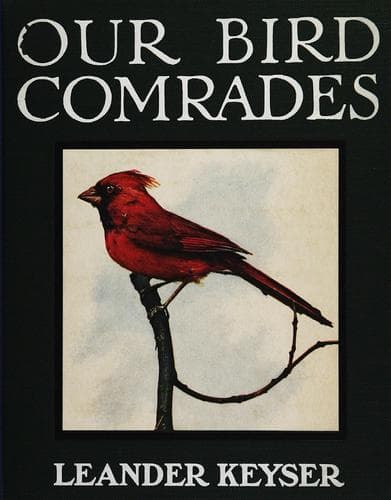
Our Bird ComradesKeyser, Leander S. (Leander Sylvester)
History
Our Bird Comrades
Keyser, Leander S. (Leander Sylvester)
Birds
"When I see him sitting quite still for a few moments on a branch of a
tree in his most characteristic nuthatch attitude, on or under the
branch, perched horizontally or vertically, with head or tail
uppermost, but always with the body placed beetle-wise against the
bark, head raised, and the straight, sharp bill pointed like an arm
lifted to denote attention,--at such times he looks less like a living
than a sculptured bird, a bird cut out of beautifully variegated
marble--blue-gray, buff, and chestnut, and placed against the tree to
deceive the eye. The figure is so smooth and compact, the tints so
soft and stone-like; and when he is still, he is so wonderfully still,
and his attitude so statuesque! But he is never long still and when he
resumes his lively, eccentric, up-and-down and sidewise motions, he is
interesting in another way. He is like a small woodpecker who has
broken loose from the woodpecker's somewhat narrow laws of progression,
preferring to be a law unto himself.
"Without a touch of brilliant color, the nuthatch is a beautiful bird
on account of the pleasing softness and harmonious disposition of his
tints; and, in like manner, without being a songster in the strict
sense of the word, his voice is so clear and far-reaching and of so
pleasing a quality, that it often gives more life and spirit to the
woods and orchards and avenues he frequents than that of many true
melodists. This is more especially the case in the month of March,
before the migratory songsters have arrived, when he is most
loquacious. A high pitched, clear, ringing note, repeated without
variation several times, is his most often-heard call or song. He will
sometimes sit motionless on his perch, repeating this call at short
intervals, for half an hour at a time. Another bird at a distance will
be doing the same, and the two appear to be answering one another. He
also has another call, not so loud and piercing, but more melodious: a
double note, repeated two or three times, with something liquid and
gurgling in the sound, suggesting the musical sound of lapsing water.
These various notes and calls are heard incessantly until the young are
hatched, when the birds at once become silent."
Public-domain text, read in full here on John Shaqi.
Reviews
Reviews
No reviews yet
Be the first to share your thoughts on this work.
Join the Discussion
Join the discussion
Sign in to leave a comment or review.
Sign InorCreate an account