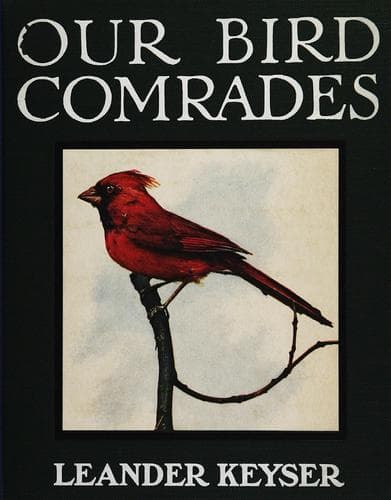
Our Bird ComradesKeyser, Leander S. (Leander Sylvester)
History
Our Bird Comrades
Keyser, Leander S. (Leander Sylvester)
Birds
In view of the almost universal character of this law it would be
strange if these peculiar forms of dependence did not appear in the
avian community. We do find such developments in that department of
creation. Across the waters there is one bird that has won an
unenviable reputation as a parasite: the European cuckoo relies almost
wholly on the efforts of its more thrifty neighbors to hatch and rear
its young, and thereby perpetuate the species. Strangely enough, our
American cuckoos are not given to such slovenly habits, but build their
own nests and faithfully perform the duties of nidification, as all
respectable feathered folk should. However, this parasitical habit
breaks out, quite unexpectedly, it must be conceded, in another
American family of birds entirely distinct from the cuckoo group.
In America the cowbird, often called the cow bunting, is the only
member of the avian household that spirits its eggs into the nests of
other birds. The theory of evolution can do little toward accounting
for the anomaly, and even if it should venture upon some suggestions it
would still be just as difficult to explain the cause of the evolution
in this special group, while all other avian groups follow the law of
thrift and self-reliance.
[Illustration: Cowbird]
The cowbird belongs to the family of birds scientifically known as
_Icteridae_, which includes such familiar species as the bobolinks,
orioles, meadowlarks, and the various kinds of blackbirds, none of
which, I am glad to say, are parasites. The name _Molothrus_ has been
given to the genus that includes the cowbirds. They are confined to
the American continent, having no analogues in the lands across the
seas. The same may be said, indeed, of the whole _Icteridae_ family.
It may be a matter of surprise to many persons that there are twelve
species and subspecies of cowbirds in North and South America, for most
of us are familiar only with the common cowbird (_Molothrus ater_) of
our temperate regions. Of these twelve species only three are to be
found within the limits of the United States, one is a resident of
western Mexico and certain parts of Central America, while the rest
find habitat exclusively in South America. A fresh field of
investigation is open to some enterprising and ambitious naturalist who
wishes to study several of these species, as comparatively little is
known of their habits, and indeed much still remains to be learned of
the whole genus, familiar as one or two of the species are. Their sly,
surreptitious manners render them exceedingly difficult to study at
close range and with anything like satisfactory detail.
Public-domain text, read in full here on John Shaqi.
Reviews
Reviews
No reviews yet
Be the first to share your thoughts on this work.
Join the Discussion
Join the discussion
Sign in to leave a comment or review.
Sign InorCreate an account