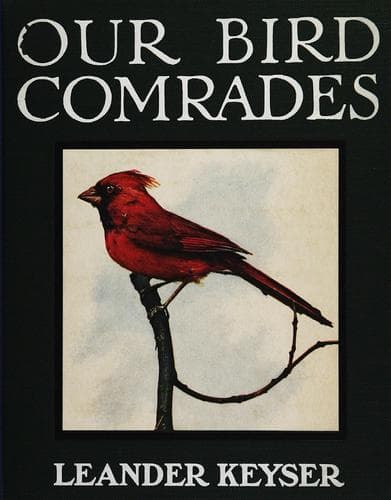
Our Bird ComradesKeyser, Leander S. (Leander Sylvester)
History
Our Bird Comrades
Keyser, Leander S. (Leander Sylvester)
Birds
But what kind of nests do the rock nuthatches construct on their
limestone walls? That is one of the most interesting features of the
life of these birds. One writer[1] who has observed them in their
native haunts describes the rock nuthatch as "an expert clay mixer and
molder." The bird does not chisel out a nursery in the rock--no,
indeed; his method of constructing his nest is as follows: Having found
a little hollow or indentation on the rocky wall, he will erect a cap
or dome of mortar over it, plastering the structure so firmly against
the surface that no rain or storm or predaceous creeping thing can
demolish it until long after it has been abandoned by the little
architect. The circular base of the nest is ten or twelve inches in
diameter. The dome is not entirely closed up, but a small orifice is
left in the center, upon the edges of which a narrow neck or funnel,
also made of mortar, is raised, the hole just large enough to admit the
body of the bird. The funnel is about three inches long.
The building material employed is fine clay softened and glutinated
with the bird's saliva and mixed with plant fibers, for the little
mason does not believe in making bricks without straw. So well packed
is the inch-thick wall that a stiff knife blade must be used to cut
through it. While the natural color of the adobe cottage is ash-gray,
and therefore harmonizes with the general hue of its surroundings, and
also with the mezzotints of the builder, yet he sometimes decorates it
with the gaily colored wings of moths caught in the chase and attached
to the plaster while it is fresh. The rock nuthatch is as expert a
mixer of mortar as the well-known cliff swallows of our own country,
and his adobe dwellings bear a close resemblance to theirs.
It is interesting to note that the European nuthatch, while nesting
regularly in tree cavities, sometimes also chooses the crannies of
rocks, when he goes a little more extensively into the plastering
business; but his skill is not so well developed as that of his
oriental cousin, whose mud cottage is a model of its kind.
[1] The writer referred to is Mr. H. C. Tracy, to whose charming
article in "The Wilson Bulletin," published at Oberlin, Ohio, I am
indebted for all my material on the rock nuthatch.
A FEATHERED PARASITE*
*Reprinted from Appleton's "Popular Science Monthly," with additions.
Nothing could more clearly prove that a common law runs through the
whole domain of Nature than the fact that in every division of her
realm there seems to be a class of parasites. In the vegetable world,
as is well known, there are various plants that depend wholly on other
plants for the supply of their vital forces. And in the human sphere
there are parasites in a very real and literal sense--men and women who
rely upon the toil and thrift of others to sustain them in worthless
idleness.
Public-domain text, read in full here on John Shaqi.
Reviews
Reviews
No reviews yet
Be the first to share your thoughts on this work.
Join the Discussion
Join the discussion
Sign in to leave a comment or review.
Sign InorCreate an account