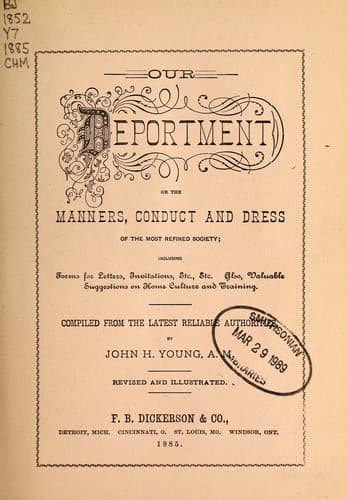
Our Deportment: Or the Manners, Conduct and Dress of the Most Refined SocietyYoung, John H.
General
Our Deportment: Or the Manners, Conduct and Dress of the Most Refined Society
Young, John H.
Etiquette
A recent English writer says: "Etiquette may be defined as the minor
morality of life. No observances, however minute, that tend to spare the
feelings of others, can be classed under the head of trivialities; and
politeness, which is but another name for general amiability, will oil
the creaking wheels of life more effectually than any of those unguents
supplied by mere wealth and station." While the social observances,
customs and rules which have grown up are numerous, and some perhaps
considered trivial, they are all grounded upon principles of kindness to
one another, and spring from the impulses of a good heart and from
friendly feelings. The truly polite man acts from the highest and
noblest ideas of what is right.
Lord Chesterfield declared good breeding to be "the result of much good
sense, some good nature and a little self-denial for the sake of others,
and with a view to obtain the same indulgence from them." Again he says:
"Good sense and good nature suggest civility in general, but in good
breeding there are a thousand little delicacies which are established
only by custom."
[Illustration]
CHAPTER II.
Our Manners.
No one quality of the mind and heart is more important as an element
conducive to worldly success than civility--that feeling of kindness and
love for our fellow-beings which is expressed in pleasing manners. Yet
how many of our young men, with an affected contempt for the forms and
conventionalities of life, assume to despise those delicate attentions,
that exquisite tenderness of thought and manner, that mark the true
gentleman.
MANNERS AS AN ELEMENT OF SUCCESS.
History repeats, over and over again, examples showing that it is the
bearing of a man toward his fellow-men which, more than any other one
quality of his nature, promotes or retards his advancement in life. The
success or failure of one's plans have often turned upon the address and
manner of the man. Though there are a few people who can look beyond the
rough husk or shell of a fellow-being to the finer qualities hidden
within, yet the vast majority, not so keen-visaged nor tolerant, judge a
person by his appearance and demeanor, more than by his substantial
character. Experience of every day life teaches us, if we would but
learn, that civility is not only one of the essentials of high success,
but that it is almost a fortune of itself, and that he who has this
quality in perfection, though a blockhead, is almost sure to succeed
where, without it, even men of good ability fail.
A good manner is the best letter of recommendation among strangers.
Civility, refinement and gentleness are passports to hearts and homes,
while awkwardness, coarseness and gruffness are met with locked doors
and closed hearts. Emerson says: "Give a boy address and
accomplishments, and you give him the mastery of palaces and fortunes
wherever he goes; he has not the trouble of earning or owning them; they
solicit him to enter and possess."
Public-domain text, read in full here on John Shaqi.
Reviews
Reviews
No reviews yet
Be the first to share your thoughts on this work.
Join the Discussion
Join the discussion
Sign in to leave a comment or review.
Sign InorCreate an account