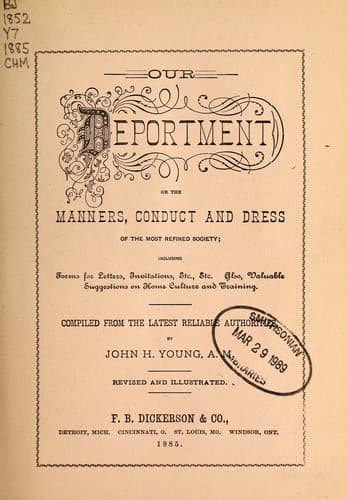
Our Deportment: Or the Manners, Conduct and Dress of the Most Refined SocietyYoung, John H.
General
Our Deportment: Or the Manners, Conduct and Dress of the Most Refined Society
Young, John H.
Etiquette
In every class of life, in all professions and occupations, good manners
are necessary to success. The business man has no stock-in-trade that
pays him better than a good address. If the retail dealer wears his hat
on his head in the presence of ladies who come to buy of him, if he does
not see that the heavy door of his shop is opened and closed for them,
if he seats himself in their presence, if he smokes a pipe or cigar, or
has a chew of tobacco in his mouth, while talking with them, or is
guilty of any of the small incivilities of life, they will not be apt to
make his shop a rendezvous, no matter how attractive the goods he
displays.
A telling preacher in his opening remarks gains the good will of his
hearers, and makes them feel both that he has something to say, and that
he can say it, by his manner. The successful medical man inspires in his
patients belief in his sympathy, and confidence in his skill, by his
manner. The lawyer, in pleading a case before a jury, and remembering
that the passions and prejudices of the jurymen govern them to as great
an extent as pure reason, must not be forgetful of his manner, if he
would bring them to his own way of thinking. And how often does the
motto, "Manners make the man," govern both parties in matters of
courtship, the lady giving preference to him whose manners indicate a
true nobility of the soul, and the gentleman preferring her who displays
in her manner a gentleness of spirit.
MANNER AN INDEX OF CHARACTER.
A rude person, though well meaning, is avoided by all. Manners, in fact,
are minor morals; and a rude person is often assumed to be a bad person.
The manner in which a person says or does a thing, furnishes a better
index of his character than what he does or says, for it is by the
incidental expression given to his thoughts and feelings, by his looks,
tones and gestures, rather than by his words and deeds, that we prefer
to judge him, for the reason that the former are involuntary. The manner
in which a favor is granted or a kindness done, often affects us more
than the deed itself. The deed may have been prompted by vanity, pride,
or some selfish motive or interest; the warmth or coldness with which
the person who has done it speaks to you, or grasps your hand, is less
likely to deceive. The manner of doing any thing, it has been truly
said, is that which stamps its life and character on any action. A favor
may be performed so grudgingly as to prevent any feeling of obligation,
or it may be refused so courteously as to awaken more kindly feelings
than if it had been ungraciously granted.
THE TRUE GENTLEMAN.
Public-domain text, read in full here on John Shaqi.
Reviews
Reviews
No reviews yet
Be the first to share your thoughts on this work.
Join the Discussion
Join the discussion
Sign in to leave a comment or review.
Sign InorCreate an account