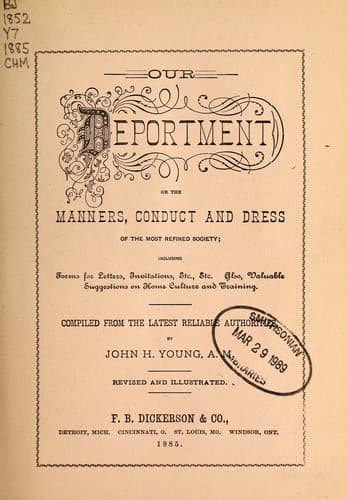
Our Deportment: Or the Manners, Conduct and Dress of the Most Refined SocietyYoung, John H.
General
Our Deportment: Or the Manners, Conduct and Dress of the Most Refined Society
Young, John H.
Etiquette
Titles in continental Europe are so common and so frequently unsustained
by landed and moneyed interests, that they have not that significance
which they hold in England. A count may be a penniless scamp, depending
upon the gambling-table for a precarious subsistence, and looking out
for the chance of making a wealthy marriage.
A German baron may be a good, substantial, unpretending man, something
after the manner of an American farmer. A German prince or duke, since
the absorption of the smaller principalities of Germany by Prussia, may
have nothing left him but a barren title and a meagre rent-roll. The
Italian prince is even of less account than the German one, since his
rent-roll is too frequently lacking altogether, and his only inheritance
may be a grand but decayed palace, without means sufficient to keep it
in repair or furnish it properly.
PRESENTATION AT THE COURT OF ST. JAMES.
It is frequently a satisfaction to an American to be presented to the
Queen during a sojourn in England, and as the Queen is really an
excellent woman, worthy of all honor, not only can there be no valid
cause for objection to such presentation, but it may well be looked upon
as an honor to be sought for.
THOSE ELIGIBLE TO PRESENTATION AT COURT.
The nobility, with their wives and daughters, are eligible to
presentation at court, unless there be some grave moral objection, in
which case, as it has ever been the aim of the good and virtuous Queen
to maintain a high standard of morality within her court, the
objectionable parties are rigidly excluded. The clergy, naval and
military officers, physicians and barristers and the squirearchy, with
their wives and daughters, have also the right to pay their personal
respects to their queen. Those of more democratic professions, such as
solicitors, merchants and mechanics, have not, as a rule, that right,
though wealth and connection have recently proven an open sesame at the
gates of St. James. Any person who has been presented at court may
present a friend in his or her turn. A person wishing to be presented,
must beg the favor from the friend or relative of the highest rank he or
she may possess.
PRELIMINARIES TO PRESENTATION.
Any nobleman or gentleman who proposes to be presented to the queen,
must leave at the lord chamberlain's office before twelve o'clock, two
days before the levee, a card with his name written thereon, and with
the name of the nobleman or gentleman by whom he is to be presented. In
order to carry out the existing regulation that no presentation can be
made at a levee except by a person actually attending that levee, it is
also necessary that a letter from the nobleman or gentleman who is to
make the presentation, stating it to be his intention to be present,
should accompany the presentation card above referred to, which will be
submitted to the queen for Her Majesty's approbation. These regulations
of the lord chamberlain must be implicitly obeyed.
Public-domain text, read in full here on John Shaqi.
Reviews
Reviews
No reviews yet
Be the first to share your thoughts on this work.
Elsewhere in the archive
Join the Discussion
Join the discussion
Sign in to leave a comment or review.
Sign InorCreate an account