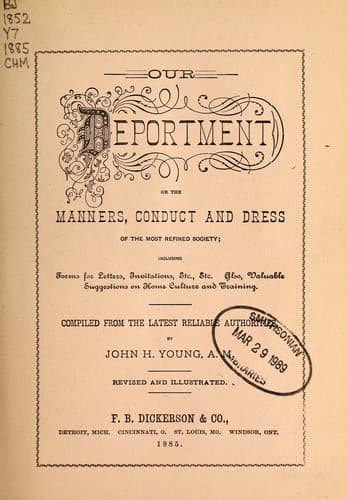
Our Deportment: Or the Manners, Conduct and Dress of the Most Refined SocietyYoung, John H.
General
Our Deportment: Or the Manners, Conduct and Dress of the Most Refined Society
Young, John H.
Etiquette
While it is not necessary to introduce people who chance to meet in your
house during a morning call; yet, if there is no reason for supposing
that such an introduction will be objectionable to either party, it
seems better to give it, as it sets both parties at ease in
conversation. Acquaintanceship may or may not follow such an
introduction, at the option of the parties. People who meet at the house
of a mutual friend need not recognize each other as acquaintances if
they meet again elsewhere, unless they choose to do so.
INTRODUCING RELATIVES.
In introducing members of your own family, be careful not only to
specify the degree of relationship, but to give the name also. It is
awkward to a stranger to be introduced to "My brother Tom," or "My
sister Carrie." When either the introducer or the introduced is a
married lady, the name of the party introduced can only be guessed at.
BESTOWING OF TITLES.
In introducing a person give him his appropriate title. If he is a
clergyman, say "The Rev. Mr. Clark." If a doctor of divinity, say "The
Rev. Dr. Clark." If he is a member of Congress, call him "Honorable,"
and specify to which branch of Congress he belongs. If he is governor of
a State, mention what State. If he is a man of any celebrity in the
world of art or letters, it is well to mention the fact something after
this manner: "Mr. Fish, the artist, whose pictures you have frequently
seen," or "Mr. Hart, author of 'Our Future State,' which you so greatly
admired."
OBLIGATORY INTRODUCTIONS.
A friend visiting at your house must be introduced to all callers, and
courtesy requires the latter to cultivate the acquaintance while your
visitor remains with you. If you are the caller introduced, you must
show the same attention to the friend of your friend that you wish shown
your own friends under the same circumstances. Persons meeting at public
places need not introduce each other to the strangers who may chance to
be with them; and, even if the introduction does take place, the
acquaintance need not be continued unless desired.
THE OBLIGATION OF AN INTRODUCTION.
Two persons who have been properly introduced have in future certain
claims upon one another's acquaintance which should be recognized,
unless there are sufficient reasons for overlooking them. Even in that
case good manners require the formal bow of recognition upon meeting,
which, of itself, encourages no familiarity. Only a very ill-bred person
will meet another with a stare.
THE SALUTATION AFTER INTRODUCTION.
Public-domain text, read in full here on John Shaqi.
Reviews
Reviews
No reviews yet
Be the first to share your thoughts on this work.
Join the Discussion
Join the discussion
Sign in to leave a comment or review.
Sign InorCreate an account