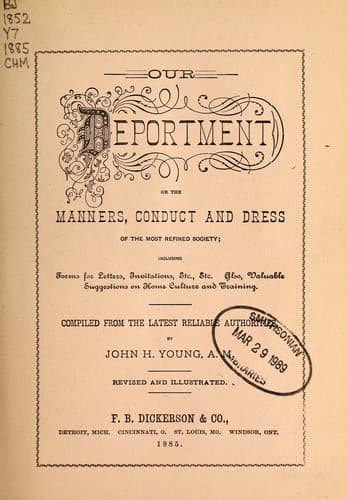
Our Deportment: Or the Manners, Conduct and Dress of the Most Refined Society — John Shaqi
Our Deportment: Or the Manners, Conduct and Dress of the Most Refined SocietyYoung, John H.
General
Our Deportment: Or the Manners, Conduct and Dress of the Most Refined Society
Young, John H.
Etiquette
It is the part of the host and hostess at a ball to introduce their
guests, though guests may, with perfect propriety, introduce each
other, or, as already intimated, may converse with one another without
the ceremony of a formal introduction. A gentleman, before introducing
his friends to ladies, should obtain permission of the latter to do so,
unless he is perfectly sure, from his knowledge of the ladies, that the
introductions will be agreeable. The ladies should always grant such
permission, unless there is a strong reason for refusing. The French,
and to some extent the English, dispense with introductions at a private
ball. The fact that they have been invited to meet each other is
regarded as a guaranty that they are fit to be mutually acquainted, and
is a sufficient warrant for self-introduction. At a public ball partners
must be introduced to each other. Special introducing may be made with
propriety by the master of ceremonies. At public balls it is well for
ladies to dance only, or for the most part, with gentlemen of their own
party, or those with whom they have had a previous acquaintance.
THE MANNER OF INTRODUCTION.
The proper form of introduction is to present the gentleman to the lady,
the younger to the older, the inferior in social standing to the
superior. In introducing, you bow to the lady and say, "Miss C., allow
me to introduce to you Mr. D. Mr. D., Miss C." It is the duty of Mr. D.
upon bowing to say, "It gives me great pleasure to form your
acquaintance, Miss C.," or a remark of this nature.
If gentlemen are to be introduced to one another, the form is, "Col.
Blank, permit me to introduce to you Mr. Cole. Mr. Cole, Col. Blank."
The exact words of an introduction are immaterial, so long as the proper
form and order is preserved.
The word "present" is often used in place of "introduce." While it is
customary to repeat the names of the two parties introduced at the close
of the introduction, it is often omitted as a useless formality. It is
of the utmost importance that each name should be spoken distinctly. If
either of the parties does not distinctly hear the name of the other he
should say at once, without hesitation or embarrassment, before making
the bow, "I beg your pardon; I did not catch (or understand) the name,"
when it may be repeated to him.
If several persons are to be introduced to one individual, mention the
name of the single individual first, and then call the others in
succession, bowing slightly as each name is pronounced.
It is the part of true politeness, after introductions, to explain to
each person introduced something of the business or residence of each,
as they will assist in opening conversation. Or, if one party has
recently returned from a foreign trip, it is courteous to say so.
CASUAL INTRODUCTIONS.
Public-domain text, read in full here on John Shaqi.
Reviews
Reviews
No reviews yet
Be the first to share your thoughts on this work.
Join the Discussion
Join the discussion
Sign in to leave a comment or review.
Sign InorCreate an account