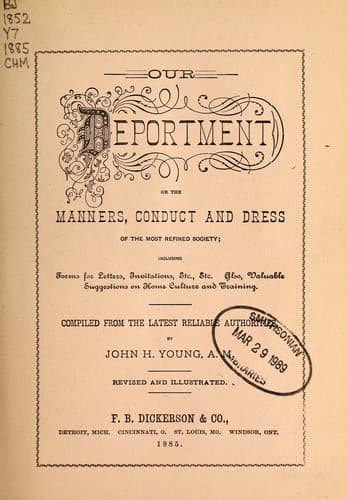
Our Deportment: Or the Manners, Conduct and Dress of the Most Refined SocietyYoung, John H.
General
Our Deportment: Or the Manners, Conduct and Dress of the Most Refined Society
Young, John H.
Etiquette
An authority upon this subject says: "The etiquette of handshaking is
simple. A man has no right to take a lady's hand until it is offered. He
has even less right to pinch or retain it. Two young ladies shake hands
gently and softly. A young lady gives her hand, but does not shake a
gentleman's unless she is his friend. A lady should always rise to give
her hand; a gentleman, of course, never dares to do so seated. On
introduction in a room, a married lady generally offers her hand; a
young lady, not. In a ball-room, where the introduction is to dancing,
not to friendship, you never shake hands; and as a general rule, an
introduction is not followed by shaking hands, only by a bow. It may
perhaps be laid down that the more public the place of introduction, the
less handshaking takes place. But if the introduction be particular, if
it be accompanied by personal recommendation, such as, 'I want you to
know my friend Jones,' or if Jones comes with a letter of presentation,
then you give Jones your hand, and warmly, too. Lastly, it is the
privilege of a superior to offer or withhold his or her hand, so that an
inferior should never put his forward first."
When a lady so far puts aside her reserve as to shake hands at all, she
should give her hand with frankness and cordiality. There should be
equal frankness and cordiality on the gentleman's part, and even more
warmth, though a careful avoidance of anything like offensive
familiarity or that which might be mistaken as such.
In shaking hands, the right hand should always be offered, unless it be
so engaged as to make it impossible, and then an excuse should be
offered. The French give the left hand, as nearest the heart.
The mistress of a household should offer her hand to every guest invited
to her house.
A gentleman must not shake hands with a lady until she has made the
first move in that direction. It is a mark of rudeness not to give his
hand instantly, should she extend her own. A married lady should always
extend her hand to a stranger brought to her house by a common friend,
as an evidence of her cordial welcome. Where an introduction is for
dancing there is no shaking of hands.
THE KISS.
This is the most affectionate form of salutation, and is only proper
among near relations and dear friends.
THE KISS OF FRIENDSHIP.
The kiss of friendship and relationship is on the cheeks and forehead.
In this country this act of affection is generally excluded from public
eyes, and in the case of parents and children and near relations, it is
perhaps unnecessarily so.
KISSING IN PUBLIC.
The custom which has become quite prevalent of women kissing each other
whenever they meet in public, is regarded as vulgar, and by ladies of
delicacy and refinement is entirely avoided.
THE KISS OF RESPECT.
The kiss of respect--almost obsolete in this country--is made on the
hand. The custom is retained in Germany and among gentlemen of the most
courtly manners in England.
[Illustration]
CHAPTER V.
Public-domain text, read in full here on John Shaqi.
Reviews
Reviews
No reviews yet
Be the first to share your thoughts on this work.
Join the Discussion
Join the discussion
Sign in to leave a comment or review.
Sign InorCreate an account