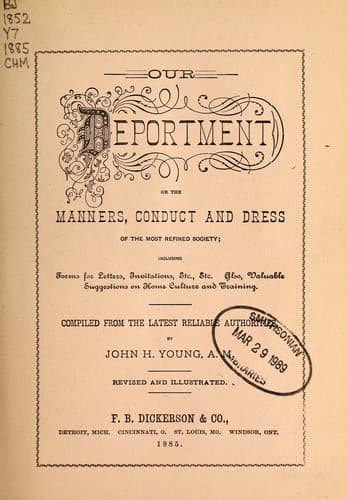
Our Deportment: Or the Manners, Conduct and Dress of the Most Refined SocietyYoung, John H.
General
Our Deportment: Or the Manners, Conduct and Dress of the Most Refined Society
Young, John H.
Etiquette
Etiquette of Calls.
There are calls of ceremony, of condolence, of congratulation and of
friendship. All but the latter are usually of short duration. The call
of friendship is usually of less formality and may be of some length.
MORNING CALLS.
"Morning calls," as they are termed, should not be made earlier than 12
P.M., nor later than 5 P.M.
A morning call should not exceed half an hour in length. From ten to
twenty minutes is ordinarily quite long enough. If other visitors come
in, the visit should terminate as speedily as possible. Upon leaving,
bow slightly to the strangers.
In making a call be careful to avoid the luncheon and dinner hour of
your friends. From two until five is ordinarily the most convenient time
for morning calls.
EVENING CALLS.
It is sometimes more convenient for both the caller and those called
upon that the call should be made in the evening. An evening call should
never be made later than nine o'clock, nor be prolonged after ten,
neither should it exceed an hour in length.
RULES FOR FORMAL CALLS.
The lady of the house rises upon the entrance of her visitors, who at
once advance to pay their respects to her before speaking to others. If
too many callers are present to enable her to take the lead in
conversation, she pays special attention to the latest arrivals,
watching to see that no one is left alone, and talking to each of her
guests in succession, or seeing that some one is doing so.
A lady who is not in her own house does not rise, either on the arrival
or departure of ladies, unless there is some great difference of age.
Attention to the aged is one of the marks of good breeding which is
never neglected by the thoughtful and refined.
It is not customary to introduce residents of the same city, unless the
hostess knows that an introduction will be agreeable to both parties.
Strangers in the place are always introduced.
Ladies and gentlemen who meet in the drawing-room of a common friend are
privileged to speak to each other without an introduction; though
gentlemen generally prefer to ask for introductions. When introduced to
any one, bow slightly, and enter at once into conversation. It shows a
lack of good breeding not to do so.
When introductions are given, it is the gentleman who should be
presented to the lady; when two ladies are introduced, it is the younger
who is presented to the older.
A lady receiving gives her hand to a stranger as to a friend, when she
wishes to bestow some mark of cordiality in welcoming a guest to her
home, but a gentleman should not take the initiatory in handshaking. It
is the lady's privilege to give or withhold, as she chooses.
A gentleman rises when those ladies with whom he is talking rise to take
their leave. He also rises upon the entrance of ladies, but he does not
offer seats to those entering, unless in his own house, or unless
requested to do so by the hostess, and then he does not offer his own
chair if others are available.
Public-domain text, read in full here on John Shaqi.
Reviews
Reviews
No reviews yet
Be the first to share your thoughts on this work.
Join the Discussion
Join the discussion
Sign in to leave a comment or review.
Sign InorCreate an account