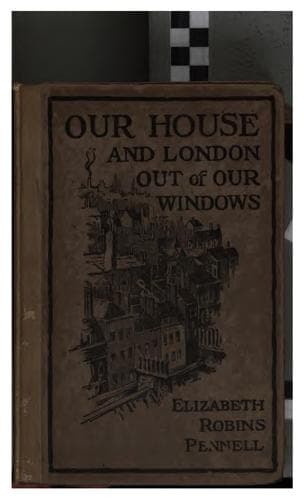
Our House and London out of Our WindowsPennell, Elizabeth Robins
General
Our House and London out of Our Windows
Pennell, Elizabeth Robins
London (England) -- Description and travel; Pennell, Elizabeth Robins, 1855-1936 -- Homes and haunts -- England -- London
The Quarter is also within an easy stroll for actors who, when their
hard times come, show an unwarranted confidence in us, though J., if
anything, disdains the theatre more than the opera. They take advantage
of their training and bring the artist's zeal to the role of Beggars,
but I have known them to be shocked back suddenly into their natural
selves by J.'s blunt refusal to hear them out. One, giving the
aristocratic name of Mr. Vivian Stewart and further describing himself
on his card as "Lead Character late of the Lyceum," was so dismayed when
J. cut his lines short with a shilling that he lost his cue entirely and
whined, "Don't you think, sir, you could make it eighteenpence?" The
most accomplished in the role was a young actor from York. He had the
intelligence to suspect that _the_ profession does not monopolize the
interest of all the world and to pretend that it did not monopolize his
own. He therefore appeared in the double part of cyclist and actor. He
reminded J. of a cycling dinner at York several winters before at which
both were present. J. remembered the dinner, but not the cyclist, who
was not a bit put out but declaimed upon "the freemasonry of the wheel,"
and anticipated J.'s joy as fellow sportsman in hearing of the new
engagement just offered to him. It would be the making of him and his
reputation, but--no bad luck has ever yet robbed our Beggars of that
useful preposition--_but_, it depended upon his leaving London within
an hour, and the usual events over which our Beggars never have control,
found him with ten shillings less than his railway fare. A loan at this
critical point would save his career, and to-morrow the money would be
returned. His visit dates back to the early period, when our hospitality
had not out-grown the barbarous stage, and his career was saved,
temporarily. After six months' silence, the actor reappeared. With his
first word of greeting he took a half sovereign from his waistcoat
pocket and regretted his delay in paying it back. _But_, in the mean
while, much had happened. He had lost his promising engagement; he had
found a wife and was on the point of losing her, for she was another of
the many wives at death's door; he had found a more promising engagement
and was on the point of losing that too, for if he did not settle his
landlady's bill before the afternoon had passed she would seize his
possessions, stage properties and all, and again events beyond his
control had emptied his pockets. He would return the ten shillings,
_but_ we must now lend him a sovereign. And he was not merely surprised
but deeply hurt because we would not, and he stayed to argue it out that
if his wife died, and his landlady kept his possessions, and the
engagement was broken, and his career was at an end, the guilt would be
ours,--it was in our power to make him or to mar him. He was really
rather good at denunciation. On this occasion it was wasted. He did not
Public-domain text, read in full here on John Shaqi.
Reviews
Reviews
No reviews yet
Be the first to share your thoughts on this work.
Elsewhere in the archive
Join the Discussion
Join the discussion
Sign in to leave a comment or review.
Sign InorCreate an account