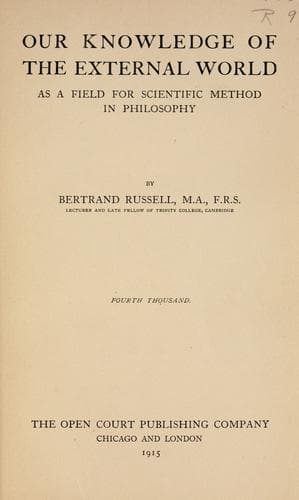
Our Knowledge of the External World as a Field for Scientific Method in Philosophy — John Shaqi
Our Knowledge of the External World as a Field for Scientific Method in PhilosophyRussell, Bertrand
Philosophy
Our Knowledge of the External World as a Field for Scientific Method in Philosophy
Russell, Bertrand
Knowledge, Theory of; Logical atomism
Produced by Jana Srna and the Online Distributed
Proofreading Team at https://www.pgdp.net
[ Transcriber's Notes:
Every effort has been made to replicate this text as faithfully
as possible, including inconsistencies in spelling and hyphenation.
Some corrections of spelling and punctuation have been made. They
are listed at the end of the text.
Italic text has been marked with _underscores_.
]
OUR KNOWLEDGE OF THE
EXTERNAL WORLD
AS A FIELD FOR SCIENTIFIC METHOD
IN PHILOSOPHY
BY THE SAME AUTHOR
INTRODUCTION TO MATHEMATICAL PHILOSOPHY
Second Edition.
Demy 8vo, 12s. 6d. net.
THE ANALYSIS OF MIND
Demy 8vo, 16s. net.
PRINCIPLES OF SOCIAL RECONSTRUCTION
Seventh Impression.
Cr. 8vo, 5s. net; Limp, 3s. 6d. net.
ROADS TO FREEDOM: SOCIALISM, ANARCHISM AND SYNDICALISM
Fourth Impression.
Cr. 8vo, 5s. net; Limp, 3s. 6d. net.
THE PRACTICE AND THEORY OF BOLSHEVISM
Second Impression.
Cr. 8vo, 6s. net.
OUR KNOWLEDGE OF
THE EXTERNAL WORLD
AS A FIELD FOR SCIENTIFIC METHOD
IN PHILOSOPHY
BY
BERTRAND RUSSELL, F.R.S
LONDON: GEORGE ALLEN & UNWIN LTD
RUSKIN HOUSE, 40 MUSEUM STREET, W.C. 1
First published in 1914 by
The Open Court Publishing Company
Reissued by George Allen & Unwin Ltd.
1922
PREFACE
The following lectures[1] are an attempt to show, by means of examples,
the nature, capacity, and limitations of the logical-analytic method in
philosophy. This method, of which the first complete example is to be
found in the writings of Frege, has gradually, in the course of actual
research, increasingly forced itself upon me as something perfectly
definite, capable of embodiment in maxims, and adequate, in all branches
of philosophy, to yield whatever objective scientific knowledge it is
possible to obtain. Most of the methods hitherto practised have
professed to lead to more ambitious results than any that logical
analysis can claim to reach, but unfortunately these results have always
been such as many competent philosophers considered inadmissible.
Regarded merely as hypotheses and as aids to imagination, the great
systems of the past serve a very useful purpose, and are abundantly
worthy of study. But something different is required if philosophy is to
become a science, and to aim at results independent of the tastes and
temperament of the philosopher who advocates them. In what follows, I
have endeavoured to show, however imperfectly, the way by which I
believe that this _desideratum_ is to be found.
[1] Delivered as Lowell Lectures in Boston, in March and April 1914.
Public-domain text, read in full here on John Shaqi.
Reviews
Reviews
No reviews yet
Be the first to share your thoughts on this work.
Join the Discussion
Join the discussion
Sign in to leave a comment or review.
Sign InorCreate an account