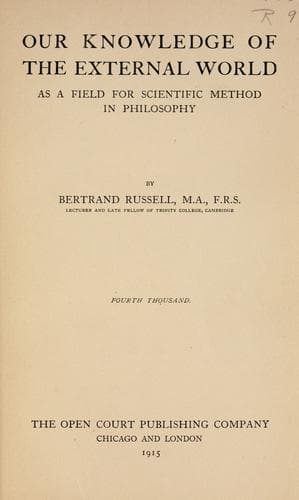
Our Knowledge of the External World as a Field for Scientific Method in PhilosophyRussell, Bertrand
Philosophy
Our Knowledge of the External World as a Field for Scientific Method in Philosophy
Russell, Bertrand
Knowledge, Theory of; Logical atomism
The kind of way in which infinity has been used to discredit the world
of sense may be illustrated by Kant's first two antinomies. In the
first, the thesis states: "The world has a beginning in time, and as
regards space is enclosed within limits"; the antithesis states: "The
world has no beginning and no limits in space, but is infinite in
respect of both time and space." Kant professes to prove both these
propositions, whereas, if what we have said on modern logic has any
truth, it must be impossible to prove either. In order, however, to
rescue the world of sense, it is enough to destroy the proof of _one_ of
the two. For our present purpose, it is the proof that the world is
_finite_ that interests us. Kant's argument as regards space here rests
upon his argument as regards time. We need therefore only examine the
argument as regards time. What he says is as follows:
"For let us assume that the world has no beginning as regards time, so
that up to every given instant an eternity has elapsed, and therefore an
infinite series of successive states of the things in the world has
passed by. But the infinity of a series consists just in this, that it
can never be completed by successive synthesis. Therefore an infinite
past world-series is impossible, and accordingly a beginning of the
world is a necessary condition of its existence; which was the first
thing to be proved."
Many different criticisms might be passed on this argument, but we will
content ourselves with a bare minimum. To begin with, it is a mistake to
define the infinity of a series as "impossibility of completion by
successive synthesis." The notion of infinity, as we shall see in the
next lecture, is primarily a property of _classes_, and only
derivatively applicable to series; classes which are infinite are given
all at once by the defining property of their members, so that there is
no question of "completion" or of "successive synthesis." And the word
"synthesis," by suggesting the mental activity of synthesising,
introduces, more or less surreptitiously, that reference to mind by
which all Kant's philosophy was infected. In the second place, when Kant
says that an infinite series can "never" be completed by successive
synthesis, all that he has even conceivably a right to say is that it
cannot be completed _in a finite time_. Thus what he really proves is,
at most, that if the world had no beginning, it must have already
existed for an infinite time. This, however, is a very poor conclusion,
by no means suitable for his purposes. And with this result we might, if
we chose, take leave of the first antinomy.
Public-domain text, read in full here on John Shaqi.
Reviews
Reviews
No reviews yet
Be the first to share your thoughts on this work.
Elsewhere in the archive
Join the Discussion
Join the discussion
Sign in to leave a comment or review.
Sign InorCreate an account