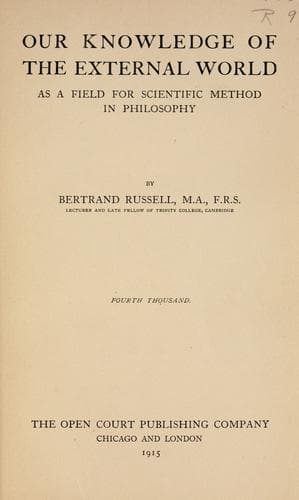
Our Knowledge of the External World as a Field for Scientific Method in PhilosophyRussell, Bertrand
Philosophy
Our Knowledge of the External World as a Field for Scientific Method in Philosophy
Russell, Bertrand
Knowledge, Theory of; Logical atomism
It is worth while, however, to consider how Kant came to make such an
elementary blunder. What happened in his imagination was obviously
something like this: Starting from the present and going backwards in
time, we have, if the world had no beginning, an infinite series of
events. As we see from the word "synthesis," he imagined a mind trying
to grasp these successively, _in the reverse order_ to that in which
they had occurred, _i.e._ going from the present backwards. _This_
series is obviously one which has no end. But the series of events up to
the present has an end, since it ends with the present. Owing to the
inveterate subjectivism of his mental habits, he failed to notice that
he had reversed the sense of the series by substituting backward
synthesis for forward happening, and thus he supposed that it was
necessary to identify the mental series, which had no end, with the
physical series, which had an end but no beginning. It was this mistake,
I think, which, operating unconsciously, led him to attribute validity
to a singularly flimsy piece of fallacious reasoning.
The second antinomy illustrates the dependence of the problem of
continuity upon that of infinity. The thesis states: "Every complex
substance in the world consists of simple parts, and there exists
everywhere nothing but the simple or what is composed of it." The
antithesis states: "No complex thing in the world consists of simple
parts, and everywhere in it there exists nothing simple." Here, as
before, the proofs of both thesis and antithesis are open to criticism,
but for the purpose of vindicating physics and the world of sense it is
enough to find a fallacy in _one_ of the proofs. We will choose for this
purpose the proof of the antithesis, which begins as follows:
"Assume that a complex thing (as substance) consists of simple parts.
Since all external relation, and therefore all composition out of
substances, is only possible in space, the space occupied by a complex
thing must consist of as many parts as the thing consists of. Now space
does not consist of simple parts, but of spaces."
The rest of his argument need not concern us, for the nerve of the proof
lies in the one statement: "Space does not consist of simple parts, but
of spaces." This is like Bergson's objection to "the absurd proposition
that motion is made up of immobilities." Kant does not tell us why he
holds that a space must consist of spaces rather than of simple parts.
Geometry regards space as made up of points, which are simple; and
although, as we have seen, this view is not scientifically or logically
_necessary_, it remains _primâ facie_ possible, and its mere possibility
is enough to vitiate Kant's argument. For, if his proof of the thesis of
the antinomy were valid, and if the antithesis could only be avoided by
assuming points, then the antinomy itself would afford a conclusive
reason in favour of points. Why, then, did Kant think it impossible that
space should be composed of points?
Public-domain text, read in full here on John Shaqi.
Reviews
Reviews
No reviews yet
Be the first to share your thoughts on this work.
Elsewhere in the archive
Join the Discussion
Join the discussion
Sign in to leave a comment or review.
Sign InorCreate an account