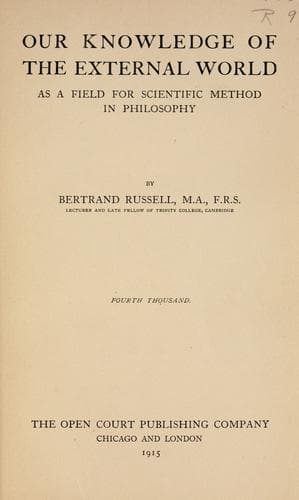
Our Knowledge of the External World as a Field for Scientific Method in Philosophy — John Shaqi
Our Knowledge of the External World as a Field for Scientific Method in PhilosophyRussell, Bertrand
Philosophy
Our Knowledge of the External World as a Field for Scientific Method in Philosophy
Russell, Bertrand
Knowledge, Theory of; Logical atomism
"But radical finalism is quite as unacceptable, and for the same reason.
The doctrine of teleology, in its extreme form, as we find it in Leibniz
for example, implies that things and beings merely realise a programme
previously arranged. But if there is nothing unforeseen, no invention or
creation in the universe, time is useless again. As in the mechanistic
hypothesis, here again it is supposed that _all is given_. Finalism thus
understood is only inverted mechanism. It springs from the same
postulate, with this sole difference, that in the movement of our finite
intellects along successive things, whose successiveness is reduced to a
mere appearance, it holds in front of us the light with which it claims
to guide us, instead of putting it behind. It substitutes the attraction
of the future for the impulsion of the past. But succession remains none
the less a mere appearance, as indeed does movement itself. In the
doctrine of Leibniz, time is reduced to a confused perception, relative
to the human standpoint, a perception which would vanish, like a rising
mist, for a mind seated at the centre of things.
"Yet finalism is not, like mechanism, a doctrine with fixed rigid
outlines. It admits of as many inflections as we like. The mechanistic
philosophy is to be taken or left: it must be left if the least grain of
dust, by straying from the path foreseen by mechanics, should show the
slightest trace of spontaneity. The doctrine of final causes, on the
contrary, will never be definitively refuted. If one form of it be put
aside, it will take another. Its principle, which is essentially
psychological, is very flexible. It is so extensible, and thereby so
comprehensive, that one accepts something of it as soon as one rejects
pure mechanism. The theory we shall put forward in this book will
therefore necessarily partake of finalism to a certain extent."
[5] _Creative Evolution_, English translation, p. 41.
Public-domain text, read in full here on John Shaqi.
Reviews
Reviews
No reviews yet
Be the first to share your thoughts on this work.
Join the Discussion
Join the discussion
Sign in to leave a comment or review.
Sign InorCreate an account