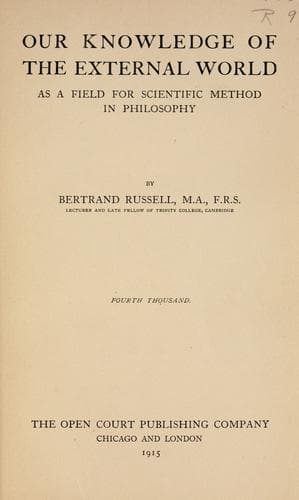
Our Knowledge of the External World as a Field for Scientific Method in PhilosophyRussell, Bertrand
Philosophy
Our Knowledge of the External World as a Field for Scientific Method in Philosophy
Russell, Bertrand
Knowledge, Theory of; Logical atomism
But if human conceit was staggered for a moment by its kinship with the
ape, it soon found a way to reassert itself, and that way is the
"philosophy" of evolution. A process which led from the amoeba to man
appeared to the philosophers to be obviously a progress--though whether
the amoeba would agree with this opinion is not known. Hence the cycle
of changes which science had shown to be the probable history of the
past was welcomed as revealing a law of development towards good in the
universe--an evolution or unfolding of an ideal slowly embodying itself
in the actual. But such a view, though it might satisfy Spencer and
those whom we may call Hegelian evolutionists, could not be accepted as
adequate by the more whole-hearted votaries of change. An ideal to which
the world continuously approaches is, to these minds, too dead and
static to be inspiring. Not only the aspirations, but the ideal too,
must change and develop with the course of evolution; there must be no
fixed goal, but a continual fashioning of fresh needs by the impulse
which is life and which alone gives unity to the process.
Ever since the seventeenth century, those whom William James described
as the "tender-minded" have been engaged in a desperate struggle with
the mechanical view of the course of nature which physical science seems
to impose. A great part of the attractiveness of the classical tradition
was due to the partial escape from mechanism which it provided. But now,
with the influence of biology, the "tender-minded" believe that a more
radical escape is possible, sweeping aside not merely the laws of
physics, but the whole apparently immutable apparatus of logic, with its
fixed concepts, its general principles, and its reasonings which seem
able to compel even the most unwilling assent. The older kind of
teleology, therefore, which regarded the End as a fixed goal, already
partially visible, towards which we were gradually approaching, is
rejected by M. Bergson as not allowing enough for the absolute dominion
of change. After explaining why he does not accept mechanism, he
proceeds:[5]
Public-domain text, read in full here on John Shaqi.
Reviews
Reviews
No reviews yet
Be the first to share your thoughts on this work.
Join the Discussion
Join the discussion
Sign in to leave a comment or review.
Sign InorCreate an account