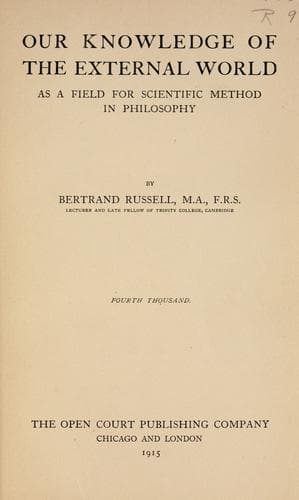
Our Knowledge of the External World as a Field for Scientific Method in PhilosophyRussell, Bertrand
Philosophy
Our Knowledge of the External World as a Field for Scientific Method in Philosophy
Russell, Bertrand
Knowledge, Theory of; Logical atomism
by the principle, still is.
[29] So Plato makes Zeno say in the _Parmenides_, apropos of his
philosophy as a whole; and all internal and external evidence supports
this view.
[30] "With Parmenides," Hegel says, "philosophising proper began."
_Werke_ (edition of 1840), vol. xiii. p. 274.
The great conception of a reality behind the passing illusions of sense,
a reality one, indivisible, and unchanging, was thus introduced into
Western philosophy by Parmenides, not, it would seem, for mystical or
religious reasons, but on the basis of a logical argument as to the
impossibility of not-being. All the great metaphysical systems--notably
those of Plato, Spinoza, and Hegel--are the outcome of this fundamental
idea. It is difficult to disentangle the truth and the error in this
view. The contention that time is unreal and that the world of sense is
illusory must, I think, be regarded as based upon fallacious reasoning.
Nevertheless, there is some sense--easier to feel than to state--in
which time is an unimportant and superficial characteristic of reality.
Past and future must be acknowledged to be as real as the present, and a
certain emancipation from slavery to time is essential to philosophic
thought. The importance of time is rather practical than theoretical,
rather in relation to our desires than in relation to truth. A truer
image of the world, I think, is obtained by picturing things as entering
into the stream of time from an eternal world outside, than from a view
which regards time as the devouring tyrant of all that is. Both in
thought and in feeling, to realise the unimportance of time is the gate
of wisdom. But unimportance is not unreality; and therefore what we
shall have to say about Zeno's arguments in support of Parmenides must
be mainly critical.
The relation of Zeno to Parmenides is explained by Plato[31] in the
dialogue in which Socrates, as a young man, learns logical acumen and
philosophic disinterestedness from their dialectic. I quote from
Jowett's translation:
"I see, Parmenides, said Socrates, that Zeno is your second self in his
writings too; he puts what you say in another way, and would fain
deceive us into believing that he is telling us what is new. For you, in
your poems, say All is one, and of this you adduce excellent proofs; and
he on the other hand says There is no Many; and on behalf of this he
offers overwhelming evidence. To deceive the world, as you have done, by
saying the same thing in different ways, one of you affirming the one,
and the other denying the many, is a strain of art beyond the reach of
most of us.
Public-domain text, read in full here on John Shaqi.
Reviews
Reviews
No reviews yet
Be the first to share your thoughts on this work.
Elsewhere in the archive
Join the Discussion
Join the discussion
Sign in to leave a comment or review.
Sign InorCreate an account