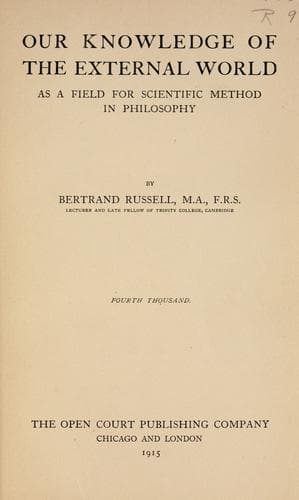
Our Knowledge of the External World as a Field for Scientific Method in PhilosophyRussell, Bertrand
Philosophy
Our Knowledge of the External World as a Field for Scientific Method in Philosophy
Russell, Bertrand
Knowledge, Theory of; Logical atomism
"Yes, Socrates, said Zeno. But although you are as keen as a Spartan
hound in pursuing the track, you do not quite apprehend the true motive
of the composition, which is not really such an ambitious work as you
imagine; for what you speak of was an accident; I had no serious
intention of deceiving the world. The truth is, that these writings of
mine were meant to protect the arguments of Parmenides against those who
scoff at him and show the many ridiculous and contradictory results
which they suppose to follow from the affirmation of the one. My answer
is an address to the partisans of the many, whose attack I return with
interest by retorting upon them that their hypothesis of the being of
the many if carried out appears in a still more ridiculous light than
the hypothesis of the being of the one."
[31] _Parmenides_, 128 A-D.
Zeno's four arguments against motion were intended to exhibit the
contradictions that result from supposing that there is such a thing as
change, and thus to support the Parmenidean doctrine that reality is
unchanging.[32] Unfortunately, we only know his arguments through
Aristotle,[33] who stated them in order to refute them. Those
philosophers in the present day who have had their doctrines stated by
opponents will realise that a just or adequate presentation of Zeno's
position is hardly to be expected from Aristotle; but by some care in
interpretation it seems possible to reconstruct the so-called "sophisms"
which have been "refuted" by every tyro from that day to this.
[32] This interpretation is combated by Milhaud, _Les
philosophes-géomètres de la Grèce_, p. 140 n., but his reasons do not
seem to me convincing. All the interpretations in what follows are
open to question, but all have the support of reputable authorities.
[33] _Physics_, vi. 9. 2396 (R.P. 136-139).
Zeno's arguments would seem to be "ad hominem"; that is to say, they
seem to assume premisses granted by his opponents, and to show that,
granting these premisses, it is possible to deduce consequences which
his opponents must deny. In order to decide whether they are valid
arguments or "sophisms," it is necessary to guess at the tacit
premisses, and to decide who was the "homo" at whom they were aimed.
Some maintain that they were aimed at the Pythagoreans,[34] while others
have held that they were intended to refute the atomists.[35] M.
Evellin, on the contrary, holds that they constitute a refutation of
infinite divisibility,[36] while M. G. Noël, in the interests of Hegel,
maintains that the first two arguments refute infinite divisibility,
while the next two refute indivisibles.[37] Amid such a bewildering
variety of interpretations, we can at least not complain of any
restrictions on our liberty of choice.
[34] _Cf._ Gaston Milhaud, _Les philosophes-géomètres de la Grèce_,
p. 140 n.; Paul Tannery, _Pour l'histoire de la science hellène_,
p. 249; Burnet, _op. cit._, p. 362.
Public-domain text, read in full here on John Shaqi.
Reviews
Reviews
No reviews yet
Be the first to share your thoughts on this work.
Elsewhere in the archive
Join the Discussion
Join the discussion
Sign in to leave a comment or review.
Sign InorCreate an account