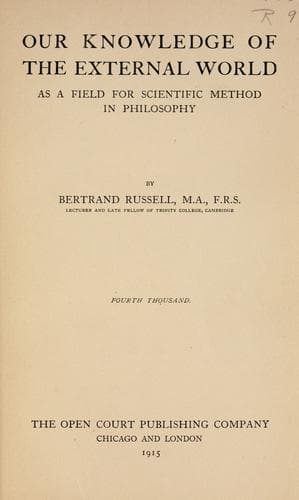
Our Knowledge of the External World as a Field for Scientific Method in PhilosophyRussell, Bertrand
Philosophy
Our Knowledge of the External World as a Field for Scientific Method in Philosophy
Russell, Bertrand
Knowledge, Theory of; Logical atomism
Zeno's arguments, in some form, have afforded grounds for almost all the
theories of space and time and infinity which have been constructed from
his day to our own. We have seen that all his arguments are valid (with
certain reasonable hypotheses) on the assumption that finite spaces and
times consist of a finite number of points and instants, and that the
third and fourth almost certainly in fact proceeded on this assumption,
while the first and second, which were perhaps intended to refute the
opposite assumption, were in that case fallacious. We may therefore
escape from his paradoxes either by maintaining that, though space and
time do consist of points and instants, the number of them in any finite
interval is infinite; or by denying that space and time consist of
points and instants at all; or lastly, by denying the reality of space
and time altogether. It would seem that Zeno himself, as a supporter of
Parmenides, drew the last of these three possible deductions, at any
rate in regard to time. In this a very large number of philosophers have
followed him. Many others, like M. Bergson, have preferred to deny that
space and time consist of points and instants. Either of these solutions
will meet the difficulties in the form in which Zeno raised them. But,
as we saw, the difficulties can also be met if infinite numbers are
admissible. And on grounds which are independent of space and time,
infinite numbers, and series in which no two terms are consecutive, must
in any case be admitted. Consider, for example, all the fractions less
than 1, arranged in order of magnitude. Between any two of them, there
are others, for example, the arithmetical mean of the two. Thus no two
fractions are consecutive, and the total number of them is infinite. It
will be found that much of what Zeno says as regards the series of
points on a line can be equally well applied to the series of fractions.
And we cannot deny that there are fractions, so that two of the above
ways of escape are closed to us. It follows that, if we are to solve the
whole class of difficulties derivable from Zeno's by analogy, we must
discover some tenable theory of infinite numbers. What, then, are the
difficulties which, until the last thirty years, led philosophers to the
belief that infinite numbers are impossible?
Public-domain text, read in full here on John Shaqi.
Reviews
Reviews
No reviews yet
Be the first to share your thoughts on this work.
Elsewhere in the archive
Join the Discussion
Join the discussion
Sign in to leave a comment or review.
Sign InorCreate an account