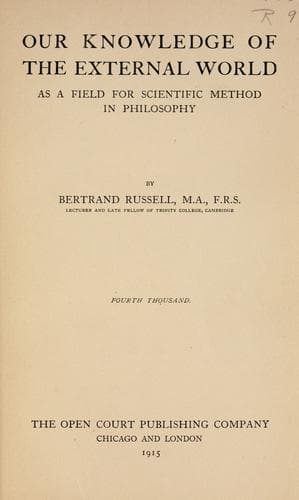
Our Knowledge of the External World as a Field for Scientific Method in PhilosophyRussell, Bertrand
Philosophy
Our Knowledge of the External World as a Field for Scientific Method in Philosophy
Russell, Bertrand
Knowledge, Theory of; Logical atomism
The difficulties of infinity are of two kinds, of which the first may be
called sham, while the others involve, for their solution, a certain
amount of new and not altogether easy thinking. The sham difficulties
are those suggested by the etymology, and those suggested by confusion
of the mathematical infinite with what philosophers impertinently call
the "true" infinite. Etymologically, "infinite" should mean "having no
end." But in fact some infinite series have ends, some have not; while
some collections are infinite without being serial, and can therefore
not properly be regarded as either endless or having ends. The series of
instants from any earlier one to any later one (both included) is
infinite, but has two ends; the series of instants from the beginning of
time to the present moment has one end, but is infinite. Kant, in his
first antinomy, seems to hold that it is harder for the past to be
infinite than for the future to be so, on the ground that the past is
now completed, and that nothing infinite can be completed. It is very
difficult to see how he can have imagined that there was any sense in
this remark; but it seems most probable that he was thinking of the
infinite as the "unended." It is odd that he did not see that the future
too has one end at the present, and is precisely on a level with the
past. His regarding the two as different in this respect illustrates
just that kind of slavery to time which, as we agreed in speaking of
Parmenides, the true philosopher must learn to leave behind him.
The confusions introduced into the notions of philosophers by the
so-called "true" infinite are curious. They see that this notion is not
the same as the mathematical infinite, but they choose to believe that
it is the notion which the mathematicians are vainly trying to reach.
They therefore inform the mathematicians, kindly but firmly, that they
are mistaken in adhering to the "false" infinite, since plainly the
"true" infinite is something quite different. The reply to this is that
what they call the "true" infinite is a notion totally irrelevant to the
problem of the mathematical infinite, to which it has only a fanciful
and verbal analogy. So remote is it that I do not propose to confuse the
issue by even mentioning what the "true" infinite is. It is the "false"
infinite that concerns us, and we have to show that the epithet "false"
is undeserved.
Public-domain text, read in full here on John Shaqi.
Reviews
Reviews
No reviews yet
Be the first to share your thoughts on this work.
Elsewhere in the archive
Join the Discussion
Join the discussion
Sign in to leave a comment or review.
Sign InorCreate an account