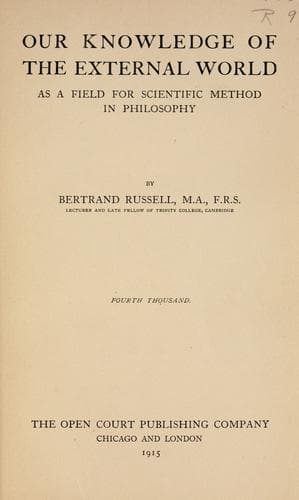
Our Knowledge of the External World as a Field for Scientific Method in PhilosophyRussell, Bertrand
Philosophy
Our Knowledge of the External World as a Field for Scientific Method in Philosophy
Russell, Bertrand
Knowledge, Theory of; Logical atomism
There are, however, certain genuine difficulties in understanding the
infinite, certain habits of mind derived from the consideration of
finite numbers, and easily extended to infinite numbers under the
mistaken notion that they represent logical necessities. For example,
every number that we are accustomed to, except 0, has another number
immediately before it, from which it results by adding 1; but the first
infinite number does not have this property. The numbers before it form
an infinite series, containing all the ordinary finite numbers, having
no maximum, no last finite number, after which one little step would
plunge us into the infinite. If it is assumed that the first infinite
number is reached by a succession of small steps, it is easy to show
that it is self-contradictory. The first infinite number is, in fact,
beyond the whole unending series of finite numbers. "But," it will be
said, "there cannot be anything beyond the whole of an unending series."
This, we may point out, is the very principle upon which Zeno relies in
the arguments of the race-course and the Achilles. Take the race-course:
there is the moment when the runner still has half his distance to run,
then the moment when he still has a quarter, then when he still has an
eighth, and so on in a strictly unending series. Beyond the whole of
this series is the moment when he reaches the goal. Thus there certainly
can be something beyond the whole of an unending series. But it remains
to show that this fact is only what might have been expected.
The difficulty, like most of the vaguer difficulties besetting the
mathematical infinite, is derived, I think, from the more or less
unconscious operation of the idea of _counting_. If you set to work to
count the terms in an infinite collection, you will never have completed
your task. Thus, in the case of the runner, if half, three-quarters,
seven-eighths, and so on of the course were marked, and the runner was
not allowed to pass any of the marks until the umpire said "Now," then
Zeno's conclusion would be true in practice, and he would never reach
the goal.
But it is not essential to the existence of a collection, or even to
knowledge and reasoning concerning it, that we should be able to pass
its terms in review one by one. This may be seen in the case of finite
collections; we can speak of "mankind" or "the human race," though many
of the individuals in this collection are not personally known to us. We
can do this because we know of various characteristics which every
individual has if he belongs to the collection, and not if he does not.
And exactly the same happens in the case of infinite collections: they
may be known by their characteristics although their terms cannot be
enumerated. In this sense, an unending series may nevertheless form a
whole, and there may be new terms beyond the whole of it.
Public-domain text, read in full here on John Shaqi.
Reviews
Reviews
No reviews yet
Be the first to share your thoughts on this work.
Elsewhere in the archive
Join the Discussion
Join the discussion
Sign in to leave a comment or review.
Sign InorCreate an account