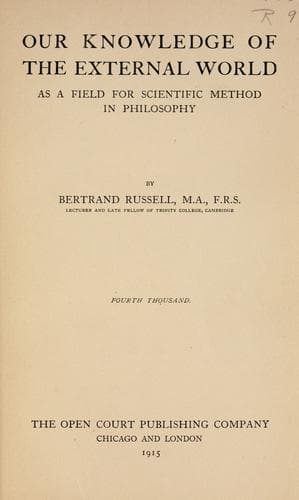
Our Knowledge of the External World as a Field for Scientific Method in PhilosophyRussell, Bertrand
Philosophy
Our Knowledge of the External World as a Field for Scientific Method in Philosophy
Russell, Bertrand
Knowledge, Theory of; Logical atomism
Some purely arithmetical peculiarities of infinite numbers have also
caused perplexity. For instance, an infinite number is not increased by
adding one to it, or by doubling it. Such peculiarities have seemed to
many to contradict logic, but in fact they only contradict confirmed
mental habits. The whole difficulty of the subject lies in the necessity
of thinking in an unfamiliar way, and in realising that many properties
which we have thought inherent in number are in fact peculiar to finite
numbers. If this is remembered, the positive theory of infinity, which
will occupy the next lecture, will not be found so difficult as it is to
those who cling obstinately to the prejudices instilled by the
arithmetic which is learnt in childhood.
LECTURE VII
THE POSITIVE THEORY OF INFINITY
The positive theory of infinity, and the general theory of number to
which it has given rise, are among the triumphs of scientific method in
philosophy, and are therefore specially suitable for illustrating the
logical-analytic character of that method. The work in this subject has
been done by mathematicians, and its results can be expressed in
mathematical symbolism. Why, then, it may be said, should the subject be
regarded as philosophy rather than as mathematics? This raises a
difficult question, partly concerned with the use of words, but partly
also of real importance in understanding the function of philosophy.
Every subject-matter, it would seem, can give rise to philosophical
investigations as well as to the appropriate science, the difference
between the two treatments being in the direction of movement and in the
kind of truths which it is sought to establish. In the special sciences,
when they have become fully developed, the movement is forward and
synthetic, from the simpler to the more complex. But in philosophy we
follow the inverse direction: from the complex and relatively concrete
we proceed towards the simple and abstract by means of analysis,
seeking, in the process, to eliminate the particularity of the original
subject-matter, and to confine our attention entirely to the logical
_form_ of the facts concerned.
Public-domain text, read in full here on John Shaqi.
Reviews
Reviews
No reviews yet
Be the first to share your thoughts on this work.
Elsewhere in the archive
Join the Discussion
Join the discussion
Sign in to leave a comment or review.
Sign InorCreate an account