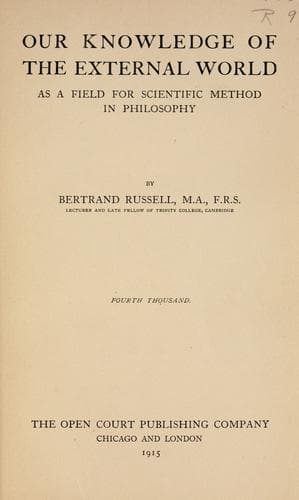
Our Knowledge of the External World as a Field for Scientific Method in PhilosophyRussell, Bertrand
Philosophy
Our Knowledge of the External World as a Field for Scientific Method in Philosophy
Russell, Bertrand
Knowledge, Theory of; Logical atomism
Between philosophy and pure mathematics there is a certain affinity, in
the fact that both are general and _a priori_. Neither of them asserts
propositions which, like those of history and geography, depend upon the
actual concrete facts being just what they are. We may illustrate this
characteristic by means of Leibniz's conception of many _possible_
worlds, of which one only is _actual_. In all the many possible worlds,
philosophy and mathematics will be the same; the differences will only
be in respect of those particular facts which are chronicled by the
descriptive sciences. Any quality, therefore, by which our actual world
is distinguished from other abstractly possible worlds, must be ignored
by mathematics and philosophy alike. Mathematics and philosophy differ,
however, in their manner of treating the general properties in which all
possible worlds agree; for while mathematics, starting from
comparatively simple propositions, seeks to build up more and more
complex results by deductive synthesis, philosophy, starting from data
which are common knowledge, seeks to purify and generalise them into the
simplest statements of abstract form that can be obtained from them by
logical analysis.
The difference between philosophy and mathematics may be illustrated by
our present problem, namely, the nature of number. Both start from
certain facts about numbers which are evident to inspection. But
mathematics uses these facts to deduce more and more complicated
theorems, while philosophy seeks, by analysis, to go behind these facts
to others, simpler, more fundamental, and inherently more fitted to form
the premisses of the science of arithmetic. The question, "What is a
number?" is the pre-eminent philosophic question in this subject, but it
is one which the mathematician as such need not ask, provided he knows
enough of the properties of numbers to enable him to deduce his
theorems. We, since our object is philosophical, must grapple with the
philosopher's question. The answer to the question, "What is a number?"
which we shall reach in this lecture, will be found to give also, by
implication, the answer to the difficulties of infinity which we
considered in the previous lecture.
Public-domain text, read in full here on John Shaqi.
Reviews
Reviews
No reviews yet
Be the first to share your thoughts on this work.
Elsewhere in the archive
Join the Discussion
Join the discussion
Sign in to leave a comment or review.
Sign InorCreate an account