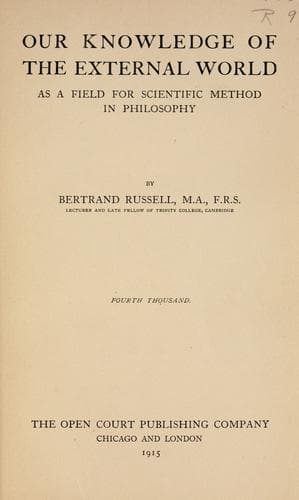
Our Knowledge of the External World as a Field for Scientific Method in PhilosophyRussell, Bertrand
Philosophy
Our Knowledge of the External World as a Field for Scientific Method in Philosophy
Russell, Bertrand
Knowledge, Theory of; Logical atomism
[50] _Mathematical Discourses concerning two new sciences relating to
mechanics and local motion, in four dialogues._ By Galileo Galilei,
Chief Philosopher and Mathematician to the Grand Duke of Tuscany. Done
into English from the Italian, by Tho. Weston, late Master, and now
published by John Weston, present Master, of the Academy at Greenwich.
See pp. 46 ff.
The way in which the problem is expounded in the above discussion is
worthy of Galileo, but the solution suggested is not the right one. It
is actually the case that the number of square (finite) numbers is the
same as the number of (finite) numbers. The fact that, so long as we
confine ourselves to numbers less than some given finite number, the
proportion of squares tends towards zero as the given finite number
increases, does not contradict the fact that the number of all finite
squares is the same as the number of all finite numbers. This is only an
instance of the fact, now familiar to mathematicians, that the _limit_
of a function as the variable _approaches_ a given point may not be the
same as its _value_ when the variable actually _reaches_ the given
point. But although the infinite numbers which Galileo discusses are
equal, Cantor has shown that what Simplicius could not conceive is true,
namely, that there are an infinite number of different infinite numbers,
and that the conception of _greater_ and _less_ can be perfectly well
applied to them. The whole of Simplicius's difficulty comes, as is
evident, from his belief that, if _greater_ and _less_ can be applied, a
part of an infinite collection must have fewer terms than the whole; and
when this is denied, all contradictions disappear. As regards greater
and less lengths of lines, which is the problem from which the above
discussion starts, that involves a meaning of _greater_ and _less_ which
is not arithmetical. The number of points is the same in a long line and
in a short one, being in fact the same as the number of points in all
space. The _greater_ and _less_ of metrical geometry involves the new
metrical conception of _congruence_, which cannot be developed out of
arithmetical considerations alone. But this question has not the
fundamental importance which belongs to the arithmetical theory of
infinity.
(2) _Non-inductiveness._--The second property by which infinite numbers
are distinguished from finite numbers is the property of
non-inductiveness. This will be best explained by defining the positive
property of inductiveness which characterises the finite numbers, and
which is named after the method of proof known as "mathematical
induction."
Public-domain text, read in full here on John Shaqi.
Reviews
Reviews
No reviews yet
Be the first to share your thoughts on this work.
Elsewhere in the archive
Join the Discussion
Join the discussion
Sign in to leave a comment or review.
Sign InorCreate an account