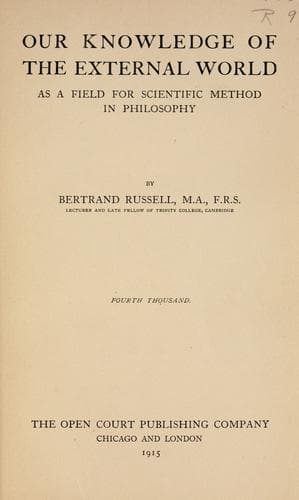
Our Knowledge of the External World as a Field for Scientific Method in PhilosophyRussell, Bertrand
Philosophy
Our Knowledge of the External World as a Field for Scientific Method in Philosophy
Russell, Bertrand
Knowledge, Theory of; Logical atomism
Let us first consider what is meant by calling a property "hereditary"
in a given series. Take such a property as being named Jones. If a man
is named Jones, so is his son; we will therefore call the property of
being called Jones hereditary with respect to the relation of father and
son. If a man is called Jones, all his descendants in the direct male
line are called Jones; this follows from the fact that the property is
hereditary. Now, instead of the relation of father and son, consider the
relation of a finite number to its immediate successor, that is, the
relation which holds between 0 and 1, between 1 and 2, between 2 and 3,
and so on. If a property of numbers is hereditary with respect to this
relation, then if it belongs to (say) 100, it must belong also to all
finite numbers greater than 100; for, being hereditary, it belongs to
101 because it belongs to 100, and it belongs to 102 because it belongs
to 101, and so on--where the "and so on" will take us, sooner or later,
to any finite number greater than 100. Thus, for example, the property
of being greater than 99 is hereditary in the series of finite numbers;
and generally, a property is hereditary in this series when, given any
number that possesses the property, the next number must always also
possess it.
It will be seen that a hereditary property, though it must belong to all
the finite numbers greater than a given number possessing the property,
need not belong to all the numbers less than this number. For example,
the hereditary property of being greater than 99 belongs to 100 and all
greater numbers, but not to any smaller number. Similarly, the
hereditary property of being called Jones belongs to all the descendants
(in the direct male line) of those who have this property, but not to
all their ancestors, because we reach at last a first Jones, before whom
the ancestors have no surname. It is obvious, however, that any
hereditary property possessed by Adam must belong to all men; and
similarly any hereditary property possessed by 0 must belong to all
finite numbers. This is the principle of what is called "mathematical
induction." It frequently happens, when we wish to prove that all finite
numbers have some property, that we have first to prove that 0 has the
property, and then that the property is hereditary, _i.e._ that, if it
belongs to a given number, then it belongs to the next number. Owing to
the fact that such proofs are called "inductive," I shall call the
properties to which they are applicable "inductive" properties. Thus an
inductive property of numbers is one which is hereditary and belongs to
0.
Public-domain text, read in full here on John Shaqi.
Reviews
Reviews
No reviews yet
Be the first to share your thoughts on this work.
Elsewhere in the archive
Join the Discussion
Join the discussion
Sign in to leave a comment or review.
Sign InorCreate an account