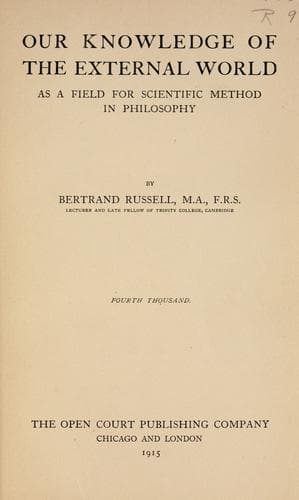
Our Knowledge of the External World as a Field for Scientific Method in PhilosophyRussell, Bertrand
Philosophy
Our Knowledge of the External World as a Field for Scientific Method in Philosophy
Russell, Bertrand
Knowledge, Theory of; Logical atomism
Taking any one of the natural numbers, say 29, it is easy to see that it
must have all inductive properties. For since such properties belong to
0 and are hereditary, they belong to 1; therefore, since they are
hereditary, they belong to 2, and so on; by twenty-nine repetitions of
such arguments we show that they belong to 29. We may _define_ the
"inductive" numbers as _all those that possess all inductive
properties_; they will be the same as what are called the "natural"
numbers, _i.e._ the ordinary finite whole numbers. To all such numbers,
proofs by mathematical induction can be validly applied. They are those
numbers, we may loosely say, which can be reached from 0 by successive
additions of 1; in other words, they are all the numbers that can be
reached by counting.
But beyond all these numbers, there are the infinite numbers, and
infinite numbers do not have all inductive properties. Such numbers,
therefore, may be called non-inductive. All those properties of numbers
which are proved by an imaginary step-by-step process from one number to
the next are liable to fail when we come to infinite numbers. The first
of the infinite numbers has no immediate predecessor, because there is
no greatest finite number; thus no succession of steps from one number
to the next will ever reach from a finite number to an infinite one, and
the step-by-step method of proof fails. This is another reason for the
supposed self-contradictions of infinite numbers. Many of the most
familiar properties of numbers, which custom had led people to regard as
logically necessary, are in fact only demonstrable by the step-by-step
method, and fail to be true of infinite numbers. But so soon as we
realise the necessity of proving such properties by mathematical
induction, and the strictly limited scope of this method of proof, the
supposed contradictions are seen to contradict, not logic, but only our
prejudices and mental habits.
Public-domain text, read in full here on John Shaqi.
Reviews
Reviews
No reviews yet
Be the first to share your thoughts on this work.
Elsewhere in the archive
Join the Discussion
Join the discussion
Sign in to leave a comment or review.
Sign InorCreate an account