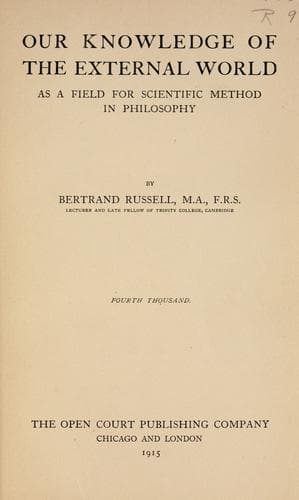
Our Knowledge of the External World as a Field for Scientific Method in PhilosophyRussell, Bertrand
Philosophy
Our Knowledge of the External World as a Field for Scientific Method in Philosophy
Russell, Bertrand
Knowledge, Theory of; Logical atomism
The property of being increased by the addition of 1--_i.e._ the
property of non-reflexiveness--may serve to illustrate the limitations
of mathematical induction. It is easy to prove that 0 is increased by
the addition of 1, and that, if a given number is increased by the
addition of 1, so is the next number, _i.e._ the number obtained by the
addition of 1. It follows that each of the natural numbers is increased
by the addition of 1. This follows generally from the general argument,
and follows for each particular case by a sufficient number of
applications of the argument. We first prove that 0 is not equal to 1;
then, since the property of being increased by 1 is hereditary, it
follows that 1 is not equal to 2; hence it follows that 2 is not equal
to 3; if we wish to prove that 30,000 is not equal to 30,001, we can do
so by repeating this reasoning 30,000 times. But we cannot prove in this
way that _all_ numbers are increased by the addition of 1; we can only
prove that this holds of the numbers attainable by successive additions
of 1 starting from 0. The reflexive numbers, which lie beyond all those
attainable in this way, are as a matter of fact not increased by the
addition of 1.
The two properties of reflexiveness and non-inductiveness, which we have
considered as characteristics of infinite numbers, have not so far been
proved to be always found together. It is known that all reflexive
numbers are non-inductive, but it is not known that all non-inductive
numbers are reflexive. Fallacious proofs of this proposition have been
published by many writers, including myself, but up to the present no
valid proof has been discovered. The infinite numbers actually known,
however, are all reflexive as well as non-inductive; thus, in
mathematical practice, if not in theory, the two properties are always
associated. For our purposes, therefore, it will be convenient to ignore
the bare possibility that there may be non-inductive non-reflexive
numbers, since all known numbers are either inductive or reflexive.
When infinite numbers are first introduced to people, they are apt to
refuse the name of numbers to them, because their behaviour is so
different from that of finite numbers that it seems a wilful misuse of
terms to call them numbers at all. In order to meet this feeling, we
must now turn to the logical basis of arithmetic, and consider the
logical definition of numbers.
Public-domain text, read in full here on John Shaqi.
Reviews
Reviews
No reviews yet
Be the first to share your thoughts on this work.
Elsewhere in the archive
Join the Discussion
Join the discussion
Sign in to leave a comment or review.
Sign InorCreate an account