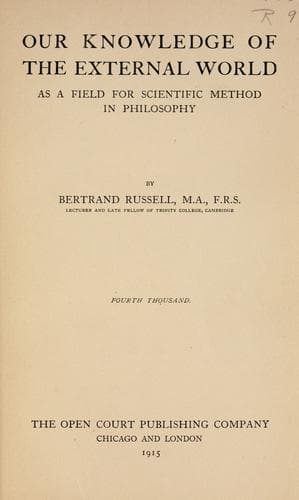
Our Knowledge of the External World as a Field for Scientific Method in PhilosophyRussell, Bertrand
Philosophy
Our Knowledge of the External World as a Field for Scientific Method in Philosophy
Russell, Bertrand
Knowledge, Theory of; Logical atomism
The logical definition of numbers, though it seems an essential support
to the theory of infinite numbers, was in fact discovered independently
and by a different man. The theory of infinite numbers--that is to say,
the arithmetical as opposed to the logical part of the theory--was
discovered by Georg Cantor, and published by him in 1882-3.[51] The
definition of number was discovered about the same time by a man whose
great genius has not received the recognition it deserves--I mean
Gottlob Frege of Jena. His first work, _Begriffsschrift_, published in
1879, contained the very important theory of hereditary properties in a
series to which I alluded in connection with inductiveness. His
definition of number is contained in his second work, published in 1884,
and entitled _Die Grundlagen der Arithmetik, eine logisch-mathematische
Untersuchung über den Begriff der Zahl_.[52] It is with this book that
the logical theory of arithmetic begins, and it will repay us to
consider Frege's analysis in some detail.
[51] In his _Grundlagen einer allgemeinen Mannichfaltigkeitslehre_ and
in articles in _Acta Mathematica_, vol. ii.
[52] The definition of number contained in this book, and elaborated
in the _Grundgesetze der Arithmetik_ (vol. i., 1893; vol. ii., 1903),
was rediscovered by me in ignorance of Frege's work. I wish to state
as emphatically as possible--what seems still often ignored--that his
discovery antedated mine by eighteen years.
Frege begins by noting the increased desire for logical strictness in
mathematical demonstrations which distinguishes modern mathematicians
from their predecessors, and points out that this must lead to a
critical investigation of the definition of number. He proceeds to show
the inadequacy of previous philosophical theories, especially of the
"synthetic _a priori_" theory of Kant and the empirical theory of Mill.
This brings him to the question: What kind of object is it that number
can properly be ascribed to? He points out that physical things may be
regarded as one or many: for example, if a tree has a thousand leaves,
they may be taken altogether as constituting its foliage, which would
count as one, not as a thousand; and _one_ pair of boots is the same
object as _two_ boots. It follows that physical things are not the
subjects of which number is properly predicated; for when we have
discovered the proper subjects, the number to be ascribed must be
unambiguous. This leads to a discussion of the very prevalent view that
number is really something psychological and subjective, a view which
Frege emphatically rejects. "Number," he says, "is as little an object
of psychology or an outcome of psychical processes as the North Sea....
The botanist wishes to state something which is just as much a fact when
he gives the number of petals in a flower as when he gives its colour.
The one depends as little as the other upon our caprice. There is
Public-domain text, read in full here on John Shaqi.
Reviews
Reviews
No reviews yet
Be the first to share your thoughts on this work.
Elsewhere in the archive
Join the Discussion
Join the discussion
Sign in to leave a comment or review.
Sign InorCreate an account