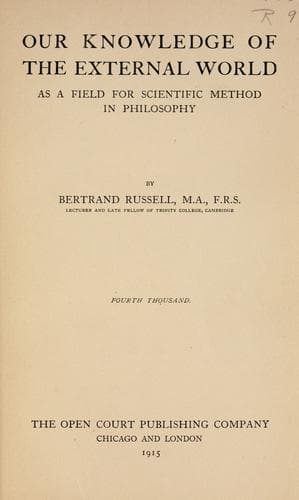
Our Knowledge of the External World as a Field for Scientific Method in PhilosophyRussell, Bertrand
Philosophy
Our Knowledge of the External World as a Field for Scientific Method in Philosophy
Russell, Bertrand
Knowledge, Theory of; Logical atomism
therefore a certain similarity between number and colour; but this does
not consist in the fact that both are sensibly perceptible in external
things, but in the fact that both are objective" (p. 34).
"I distinguish the objective," he continues, "from the palpable, the
spatial, the actual. The earth's axis, the centre of mass of the solar
system, are objective, but I should not call them actual, like the earth
itself" (p. 35). He concludes that number is neither spatial and
physical, nor subjective, but non-sensible and objective. This
conclusion is important, since it applies to all the subject-matter of
mathematics and logic. Most philosophers have thought that the physical
and the mental between them exhausted the world of being. Some have
argued that the objects of mathematics were obviously not subjective,
and therefore must be physical and empirical; others have argued that
they were obviously not physical, and therefore must be subjective and
mental. Both sides were right in what they denied, and wrong in what
they asserted; Frege has the merit of accepting both denials, and
finding a third assertion by recognising the world of logic, which is
neither mental nor physical.
The fact is, as Frege points out, that no number, not even 1, is
applicable to physical things, but only to general terms or
descriptions, such as "man," "satellite of the earth," "satellite of
Venus." The general term "man" is applicable to a certain number of
objects: there are in the world so and so many men. The unity which
philosophers rightly feel to be necessary for the assertion of a number
is the unity of the general term, and it is the general term which is
the proper subject of number. And this applies equally when there is one
object or none which falls under the general term. "Satellite of the
earth" is a term only applicable to one object, namely, the moon. But
"one" is not a property of the moon itself, which may equally well be
regarded as many molecules: it is a property of the general term
"earth's satellite." Similarly, 0 is a property of the general term
"satellite of Venus," because Venus has no satellite. Here at last we
have an intelligible theory of the number 0. This was impossible if
numbers applied to physical objects, because obviously no physical
object could have the number 0. Thus, in seeking our definition of
number we have arrived so far at the result that numbers are properties
of general terms or general descriptions, not of physical things or of
mental occurrences.
Public-domain text, read in full here on John Shaqi.
Reviews
Reviews
No reviews yet
Be the first to share your thoughts on this work.
Elsewhere in the archive
Join the Discussion
Join the discussion
Sign in to leave a comment or review.
Sign InorCreate an account