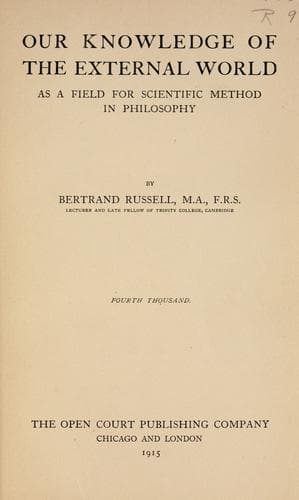
Our Knowledge of the External World as a Field for Scientific Method in PhilosophyRussell, Bertrand
Philosophy
Our Knowledge of the External World as a Field for Scientific Method in Philosophy
Russell, Bertrand
Knowledge, Theory of; Logical atomism
Instead of speaking of a general term, such as "man," as the subject of
which a number can be asserted, we may, without making any serious
change, take the subject as the class or collection of objects--_i.e._
"mankind" in the above instance--to which the general term in question
is applicable. Two general terms, such as "man" and "featherless biped,"
which are applicable to the same collection of objects, will obviously
have the same number of instances; thus the number depends upon the
class, not upon the selection of this or that general term to describe
it, provided several general terms can be found to describe the same
class. But some general term is always necessary in order to describe a
class. Even when the terms are enumerated, as "this and that and the
other," the collection is constituted by the general property of being
either this, or that, or the other, and only so acquires the unity which
enables us to speak of it as _one_ collection. And in the case of an
infinite class, enumeration is impossible, so that description by a
general characteristic common and peculiar to the members of the class
is the only possible description. Here, as we see, the theory of number
to which Frege was led by purely logical considerations becomes of use
in showing how infinite classes can be amenable to number in spite of
being incapable of enumeration.
Frege next asks the question: When do two collections have the same
number of terms? In ordinary life, we decide this question by counting;
but counting, as we saw, is impossible in the case of infinite
collections, and is not logically fundamental with finite collections.
We want, therefore, a different method of answering our question. An
illustration may help to make the method clear. I do not know how many
married men there are in England, but I do know that the number is the
same as the number of married women. The reason I know this is that the
relation of husband and wife relates one man to one woman and one woman
to one man. A relation of this sort is called a one-one relation. The
relation of father to son is called a one-many relation, because a man
can have only one father but may have many sons; conversely, the
relation of son to father is called a many-one relation. But the
relation of husband to wife (in Christian countries) is called one-one,
because a man cannot have more than one wife, or a woman more than one
husband. Now, whenever there is a one-one relation between all the terms
of one collection and all the terms of another severally, as in the case
of English husbands and English wives, the number of terms in the one
collection is the same as the number in the other; but when there is not
such a relation, the number is different. This is the answer to the
question: When do two collections have the same number of terms?
Public-domain text, read in full here on John Shaqi.
Reviews
Reviews
No reviews yet
Be the first to share your thoughts on this work.
Elsewhere in the archive
Join the Discussion
Join the discussion
Sign in to leave a comment or review.
Sign InorCreate an account