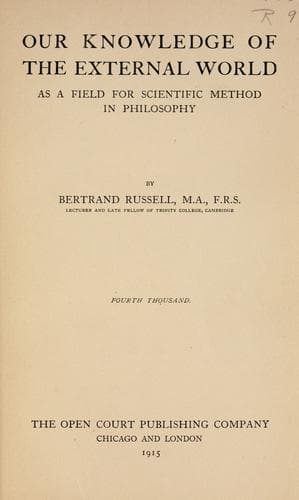
Our Knowledge of the External World as a Field for Scientific Method in PhilosophyRussell, Bertrand
Philosophy
Our Knowledge of the External World as a Field for Scientific Method in Philosophy
Russell, Bertrand
Knowledge, Theory of; Logical atomism
We can now at last answer the question: What is meant by the number of
terms in a given collection? When there is a one-one relation between
all the terms of one collection and all the terms of another severally,
we shall say that the two collections are "similar." We have just seen
that two similar collections have the same number of terms. This leads
us to define the number of a given collection as the class of all
collections that are similar to it; that is to say, we set up the
following formal definition:
"The number of terms in a given class" is defined as meaning "the class
of all classes that are similar to the given class."
This definition, as Frege (expressing it in slightly different terms)
showed, yields the usual arithmetical properties of numbers. It is
applicable equally to finite and infinite numbers, and it does not
require the admission of some new and mysterious set of metaphysical
entities. It shows that it is not physical objects, but classes or the
general terms by which they are defined, of which numbers can be
asserted; and it applies to 0 and 1 without any of the difficulties
which other theories find in dealing with these two special cases.
The above definition is sure to produce, at first sight, a feeling of
oddity, which is liable to cause a certain dissatisfaction. It defines
the number 2, for instance, as the class of all couples, and the number
3 as the class of all triads. This does not _seem_ to be what we have
hitherto been meaning when we spoke of 2 and 3, though it would be
difficult to say _what_ we had been meaning. The answer to a feeling
cannot be a logical argument, but nevertheless the answer in this case
is not without importance. In the first place, it will be found that
when an idea which has grown familiar as an unanalysed whole is first
resolved accurately into its component parts--which is what we do when
we define it--there is almost always a feeling of unfamiliarity produced
by the analysis, which tends to cause a protest against the definition.
In the second place, it may be admitted that the definition, like all
definitions, is to a certain extent arbitrary. In the case of the small
finite numbers, such as 2 and 3, it would be possible to frame
definitions more nearly in accordance with our unanalysed feeling of
what we mean; but the method of such definitions would lack uniformity,
and would be found to fail sooner or later--at latest when we reached
infinite numbers.
Public-domain text, read in full here on John Shaqi.
Reviews
Reviews
No reviews yet
Be the first to share your thoughts on this work.
Elsewhere in the archive
Join the Discussion
Join the discussion
Sign in to leave a comment or review.
Sign InorCreate an account