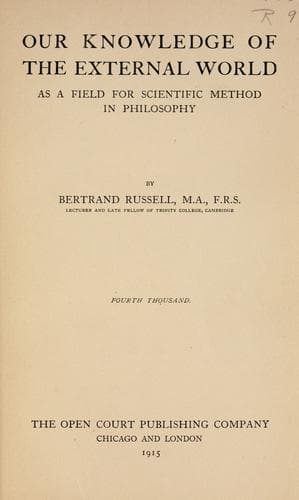
Our Knowledge of the External World as a Field for Scientific Method in PhilosophyRussell, Bertrand
Philosophy
Our Knowledge of the External World as a Field for Scientific Method in Philosophy
Russell, Bertrand
Knowledge, Theory of; Logical atomism
In the third place, the real desideratum about such a definition as that
of number is not that it should represent as nearly as possible the
ideas of those who have not gone through the analysis required in order
to reach a definition, but that it should give us objects having the
requisite properties. Numbers, in fact, must satisfy the formulæ of
arithmetic; any indubitable set of objects fulfilling this requirement
may be called numbers. So far, the simplest set known to fulfil this
requirement is the set introduced by the above definition. In comparison
with this merit, the question whether the objects to which the
definition applies are like or unlike the vague ideas of numbers
entertained by those who cannot give a definition, is one of very little
importance. All the important requirements are fulfilled by the above
definition, and the sense of oddity which is at first unavoidable will
be found to wear off very quickly with the growth of familiarity.
There is, however, a certain logical doctrine which may be thought to
form an objection to the above definition of numbers as classes of
classes--I mean the doctrine that there are no such objects as classes
at all. It might be thought that this doctrine would make havoc of a
theory which reduces numbers to classes, and of the many other theories
in which we have made use of classes. This, however, would be a mistake:
none of these theories are any the worse for the doctrine that classes
are fictions. What the doctrine is, and why it is not destructive, I
will try briefly to explain.
On account of certain rather complicated difficulties, culminating in
definite contradictions, I was led to the view that nothing that can be
said significantly about things, _i.e._ particulars, can be said
significantly (_i.e._ either truly or falsely) about classes of things.
That is to say, if, in any sentence in which a thing is mentioned, you
substitute a class for the thing, you no longer have a sentence that has
any meaning: the sentence is no longer either true or false, but a
meaningless collection of words. Appearances to the contrary can be
dispelled by a moment's reflection. For example, in the sentence, "Adam
is fond of apples," you may substitute _mankind_, and say, "Mankind is
fond of apples." But obviously you do not mean that there is one
individual, called "mankind," which munches apples: you mean that the
separate individuals who compose mankind are each severally fond of
apples.
Public-domain text, read in full here on John Shaqi.
Reviews
Reviews
No reviews yet
Be the first to share your thoughts on this work.
Elsewhere in the archive
Join the Discussion
Join the discussion
Sign in to leave a comment or review.
Sign InorCreate an account