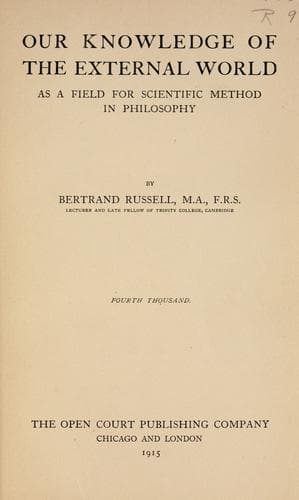
Our Knowledge of the External World as a Field for Scientific Method in PhilosophyRussell, Bertrand
Philosophy
Our Knowledge of the External World as a Field for Scientific Method in Philosophy
Russell, Bertrand
Knowledge, Theory of; Logical atomism
Now, if nothing that can be said significantly about a thing can be said
significantly about a class of things, it follows that classes of things
cannot have the same kind of reality as things have; for if they had, a
class could be substituted for a thing in a proposition predicating the
kind of reality which would be common to both. This view is really
consonant to common sense. In the third or fourth century B.C. there
lived a Chinese philosopher named Hui Tzŭ, who maintained that "a bay
horse and a dun cow are three; because taken separately they are two,
and taken together they are one: two and one make three."[53] The author
from whom I quote says that Hui Tzŭ "was particularly fond of the
quibbles which so delighted the sophists or unsound reasoners of ancient
Greece," and this no doubt represents the judgment of common sense upon
such arguments. Yet if collections of things were things, his contention
would be irrefragable. It is only because the bay horse and the dun cow
taken together are not a new thing that we can escape the conclusion
that there are three things wherever there are two.
[53] Giles, _The Civilisation of China_ (Home University Library),
p. 147.
When it is admitted that classes are not things, the question arises:
What do we mean by statements which are nominally about classes? Take
such a statement as, "The class of people interested in mathematical
logic is not very numerous." Obviously this reduces itself to, "Not very
many people are interested in mathematical logic." For the sake of
definiteness, let us substitute some particular number, say 3, for "very
many." Then our statement is, "Not three people are interested in
mathematical logic." This may be expressed in the form: "If _x_ is
interested in mathematical logic, and also _y_ is interested, and also
_z_ is interested, then _x_ is identical with _y_, or _x_ is identical
with _z_, or _y_ is identical with _z_." Here there is no longer any
reference at all to a "class." In some such way, all statements
nominally about a class can be reduced to statements about what follows
from the hypothesis of anything's having the defining property of the
class. All that is wanted, therefore, in order to render the _verbal_
use of classes legitimate, is a uniform method of interpreting
propositions in which such a use occurs, so as to obtain propositions in
which there is no longer any such use. The definition of such a method
is a technical matter, which Dr Whitehead and I have dealt with
elsewhere, and which we need not enter into on this occasion.[54]
[54] Cf. _Principia Mathematica_, § 20, and Introduction, chapter iii.
Public-domain text, read in full here on John Shaqi.
Reviews
Reviews
No reviews yet
Be the first to share your thoughts on this work.
Elsewhere in the archive
Join the Discussion
Join the discussion
Sign in to leave a comment or review.
Sign InorCreate an account