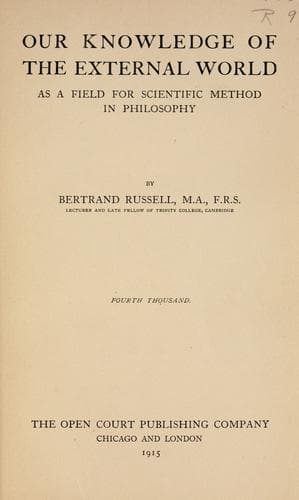
Our Knowledge of the External World as a Field for Scientific Method in PhilosophyRussell, Bertrand
Philosophy
Our Knowledge of the External World as a Field for Scientific Method in Philosophy
Russell, Bertrand
Knowledge, Theory of; Logical atomism
If the theory that classes are merely symbolic is accepted, it follows
that numbers are not actual entities, but that propositions in which
numbers verbally occur have not really any constituents corresponding to
numbers, but only a certain logical form which is not a part of
propositions having this form. This is in fact the case with all the
apparent objects of logic and mathematics. Such words as _or_, _not_,
_if_, _there is_, _identity_, _greater_, _plus_, _nothing_,
_everything_, _function_, and so on, are not names of definite objects,
like "John" or "Jones," but are words which require a context in order
to have meaning. All of them are _formal_, that is to say, their
occurrence indicates a certain form of proposition, not a certain
constituent. "Logical constants," in short, are not entities; the words
expressing them are not names, and cannot significantly be made into
logical subjects except when it is the words themselves, as opposed to
their meanings, that are being discussed.[55] This fact has a very
important bearing on all logic and philosophy, since it shows how they
differ from the special sciences. But the questions raised are so large
and so difficult that it is impossible to pursue them further on this
occasion.
[55] In the above remarks I am making use of unpublished work by my
friend Ludwig Wittgenstein.
LECTURE VIII
ON THE NOTION OF CAUSE, WITH APPLICATIONS TO THE FREE-WILL PROBLEM
The nature of philosophic analysis, as illustrated in our previous
lectures, can now be stated in general terms. We start from a body of
common knowledge, which constitutes our data. On examination, the data
are found to be complex, rather vague, and largely interdependent
logically. By analysis we reduce them to propositions which are as
nearly as possible simple and precise, and we arrange them in deductive
chains, in which a certain number of initial propositions form a logical
guarantee for all the rest. These initial propositions are _premisses_
for the body of knowledge in question. Premisses are thus quite
different from data--they are simpler, more precise, and less infected
with logical redundancy. If the work of analysis has been performed
completely, they will be wholly free from logical redundancy, wholly
precise, and as simple as is logically compatible with their leading to
the given body of knowledge. The discovery of these premisses belongs to
philosophy; but the work of deducing the body of common knowledge from
them belongs to mathematics, if "mathematics" is interpreted in a
somewhat liberal sense.
Public-domain text, read in full here on John Shaqi.
Reviews
Reviews
No reviews yet
Be the first to share your thoughts on this work.
Elsewhere in the archive
Join the Discussion
Join the discussion
Sign in to leave a comment or review.
Sign InorCreate an account