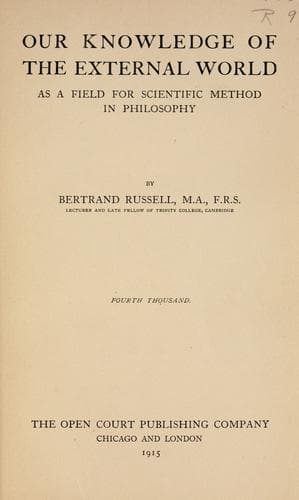
Our Knowledge of the External World as a Field for Scientific Method in PhilosophyRussell, Bertrand
Philosophy
Our Knowledge of the External World as a Field for Scientific Method in Philosophy
Russell, Bertrand
Knowledge, Theory of; Logical atomism
But besides the logical analysis of the common knowledge which forms our
data, there is the consideration of its degree of certainty. When we
have arrived at its premisses, we may find that some of them seem open
to doubt, and we may find further that this doubt extends to those of
our original data which depend upon these doubtful premisses. In our
third lecture, for example, we saw that the part of physics which
depends upon testimony, and thus upon the existence of other minds than
our own, does not seem so certain as the part which depends exclusively
upon our own sense-data and the laws of logic. Similarly, it used to be
felt that the parts of geometry which depend upon the axiom of parallels
have less certainty than the parts which are independent of this
premiss. We may say, generally, that what commonly passes as knowledge
is not all equally certain, and that, when analysis into premisses has
been effected, the degree of certainty of any consequence of the
premisses will depend upon that of the most doubtful premiss employed in
proving this consequence. Thus analysis into premisses serves not only a
logical purpose, but also the purpose of facilitating an estimate as to
the degree of certainty to be attached to this or that derivative
belief. In view of the fallibility of all human beliefs, this service
seems at least as important as the purely logical services rendered by
philosophical analysis.
In the present lecture, I wish to apply the analytic method to the
notion of "cause," and to illustrate the discussion by applying it to
the problem of free will. For this purpose I shall inquire: I., what is
meant by a causal law; II., what is the evidence that causal laws have
held hitherto; III., what is the evidence that they will continue to
hold in the future; IV., how the causality which is used in science
differs from that of common sense and traditional philosophy; V., what
new light is thrown on the question of free will by our analysis of the
notion of "cause."
I. By a "causal law" I mean any general proposition in virtue of which
it is possible to infer the existence of one thing or event from the
existence of another or of a number of others. If you hear thunder
without having seen lightning, you infer that there nevertheless was a
flash, because of the general proposition, "All thunder is preceded by
lightning." When Robinson Crusoe sees a footprint, he infers a human
being, and he might justify his inference by the general proposition,
"All marks in the ground shaped like a human foot are subsequent to a
human being's standing where the marks are." When we see the sun set, we
expect that it will rise again the next day. When we hear a man
speaking, we infer that he has certain thoughts. All these inferences
are due to causal laws.
Public-domain text, read in full here on John Shaqi.
Reviews
Reviews
No reviews yet
Be the first to share your thoughts on this work.
Elsewhere in the archive
Join the Discussion
Join the discussion
Sign in to leave a comment or review.
Sign InorCreate an account