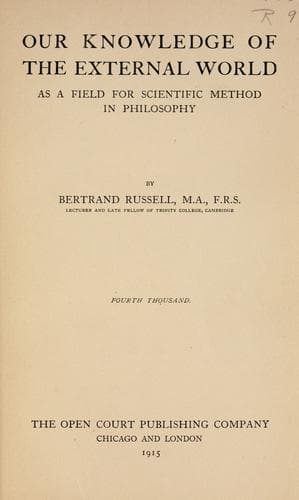
Our Knowledge of the External World as a Field for Scientific Method in PhilosophyRussell, Bertrand
Philosophy
Our Knowledge of the External World as a Field for Scientific Method in Philosophy
Russell, Bertrand
Knowledge, Theory of; Logical atomism
A causal law, we said, allows us to infer the existence of one _thing_
(or _event_) from the existence of one or more others. The word "thing"
here is to be understood as only applying to particulars, _i.e._ as
excluding such logical objects as numbers or classes or abstract
properties and relations, and including sense-data, with whatever is
logically of the same type as sense-data.[56] In so far as a causal law
is directly verifiable, the thing inferred and the thing from which it
is inferred must both be data, though they need not both be data at the
same time. In fact, a causal law which is being used to extend our
knowledge of existence must be applied to what, at the moment, is not a
datum; it is in the possibility of such application that the practical
utility of a causal law consists. The important point, for our present
purpose, however, is that what is inferred is a "thing," a "particular,"
an object having the kind of reality that belongs to objects of sense,
not an abstract object such as virtue or the square root of two.
[56] Thus we are not using "thing" here in the sense of a class of
correlated "aspects," as we did in Lecture III. Each "aspect" will
count separately in stating causal laws.
But we cannot become acquainted with a particular except by its being
actually given. Hence the particular inferred by a causal law must be
only _described_ with more or less exactness; it cannot be _named_ until
the inference is verified. Moreover, since the causal law is _general_,
and capable of applying to many cases, the given particular from which
we infer must allow the inference in virtue of some general
characteristic, not in virtue of its being just the particular that it
is. This is obvious in all our previous instances: we infer the
unperceived lightning from the thunder, not in virtue of any peculiarity
of the thunder, but in virtue of its resemblance to other claps of
thunder. Thus a causal law must state that the existence of a thing of a
certain sort (or of a number of things of a number of assigned sorts)
implies the existence of another thing having a relation to the first
which remains invariable so long as the first is of the kind in
question.
It is to be observed that what is constant in a causal law is not the
object or objects given, nor yet the object inferred, both of which may
vary within wide limits, but the _relation_ between what is given and
what is inferred. The principle, "same cause, same effect," which is
sometimes said to be the principle of causality, is much narrower in its
scope than the principle which really occurs in science; indeed, if
strictly interpreted, it has no scope at all, since the "same" cause
never recurs exactly. We shall return to this point at a later stage of
the discussion.
Public-domain text, read in full here on John Shaqi.
Reviews
Reviews
No reviews yet
Be the first to share your thoughts on this work.
Elsewhere in the archive
Join the Discussion
Join the discussion
Sign in to leave a comment or review.
Sign InorCreate an account