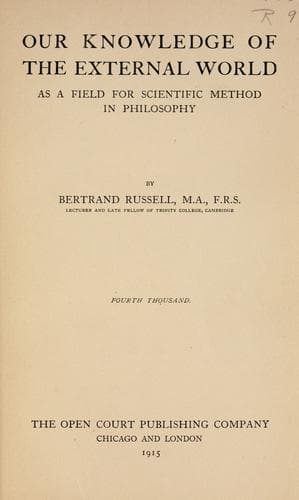
Our Knowledge of the External World as a Field for Scientific Method in PhilosophyRussell, Bertrand
Philosophy
Our Knowledge of the External World as a Field for Scientific Method in Philosophy
Russell, Bertrand
Knowledge, Theory of; Logical atomism
The particular which is inferred may be uniquely determined by the
causal law, or may be only described in such general terms that many
different particulars might satisfy the description. This depends upon
whether the constant relation affirmed by the causal law is one which
only one term can have to the data, or one which many terms may have. If
many terms may have the relation in question, science will not be
satisfied until it has found some more stringent law, which will enable
us to determine the inferred things uniquely.
Since all known things are in time, a causal law must take account of
temporal relations. It will be part of the causal law to state a
relation of succession or coexistence between the thing given and the
thing inferred. When we hear thunder and infer that there was lightning,
the law states that the thing inferred is earlier than the thing given.
Conversely, when we see lightning and wait expectantly for the thunder,
the law states that the thing given is earlier than the thing inferred.
When we infer a man's thoughts from his words, the law states that the
two are (at least approximately) simultaneous.
If a causal law is to achieve the precision at which science aims, it
must not be content with a vague _earlier_ or _later_, but must state
how much earlier or how much later. That is to say, the time-relation
between the thing given and the thing inferred ought to be capable of
exact statement; and usually the inference to be drawn is different
according to the length and direction of the interval. "A quarter of an
hour ago this man was alive; an hour hence he will be cold." Such a
statement involves two causal laws, one inferring from a datum something
which existed a quarter of an hour ago, the other inferring from the
same datum something which will exist an hour hence.
Often a causal law involves not one datum, but many, which need not be
all simultaneous with each other, though their time-relations must be
given. The general scheme of a causal law will be as follows:
"Whenever things occur in certain relations to each other (among which
their time-relations must be included), then a thing having a fixed
relation to these things will occur at a date fixed relatively to their
dates."
The things given will not, in practice, be things that only exist for an
instant, for such things, if there are any, can never be data. The
things given will each occupy some finite time. They may be not static
things, but processes, especially motions. We have considered in an
earlier lecture the sense in which a motion may be a datum, and need not
now recur to this topic.
It is not essential to a causal law that the object inferred should be
later than some or all of the data. It may equally well be earlier or at
the same time. The only thing essential is that the law should be such
as to enable us to infer the existence of an object which we can more or
less accurately describe in terms of the data.
Public-domain text, read in full here on John Shaqi.
Reviews
Reviews
No reviews yet
Be the first to share your thoughts on this work.
Elsewhere in the archive
Join the Discussion
Join the discussion
Sign in to leave a comment or review.
Sign InorCreate an account