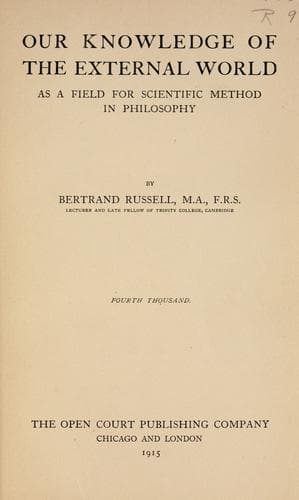
Our Knowledge of the External World as a Field for Scientific Method in PhilosophyRussell, Bertrand
Philosophy
Our Knowledge of the External World as a Field for Scientific Method in Philosophy
Russell, Bertrand
Knowledge, Theory of; Logical atomism
II. I come now to our second question, namely: What is the nature of the
evidence that causal laws have held hitherto, at least in the observed
portions of the past? This question must not be confused with the
further question: Does this evidence warrant us in assuming the truth of
causal laws in the future and in unobserved portions of the past? For
the present, I am only asking what are the grounds which lead to a
belief in causal laws, not whether these grounds are adequate to support
the belief in universal causation.
The first step is the discovery of approximate unanalysed uniformities
of sequence or coexistence. After lightning comes thunder, after a blow
received comes pain, after approaching a fire comes warmth; again, there
are uniformities of coexistence, for example between touch and sight,
between certain sensations in the throat and the sound of one's own
voice, and so on. Every such uniformity of sequence or coexistence,
after it has been experienced a certain number of times, is followed by
an expectation that it will be repeated on future occasions, _i.e._ that
where one of the correlated events is found, the other will be found
also. The connection of experienced past uniformity with expectation as
to the future is just one of those uniformities of sequence which we
have observed to be true hitherto. This affords a psychological account
of what may be called the animal belief in causation, because it is
something which can be observed in horses and dogs, and is rather a
habit of acting than a real belief. So far, we have merely repeated
Hume, who carried the discussion of cause up to this point, but did not,
apparently, perceive how much remained to be said.
Is there, in fact, any characteristic, such as might be called causality
or uniformity, which is found to hold throughout the observed past? And
if so, how is it to be stated?
Public-domain text, read in full here on John Shaqi.
Reviews
Reviews
No reviews yet
Be the first to share your thoughts on this work.
Elsewhere in the archive
Join the Discussion
Join the discussion
Sign in to leave a comment or review.
Sign InorCreate an account