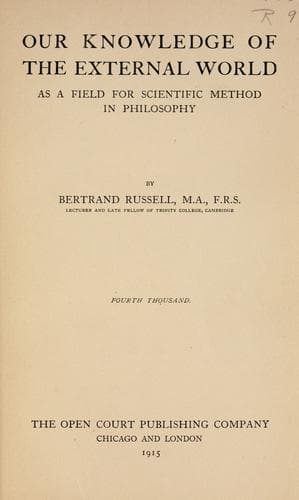
Our Knowledge of the External World as a Field for Scientific Method in PhilosophyRussell, Bertrand
Philosophy
Our Knowledge of the External World as a Field for Scientific Method in Philosophy
Russell, Bertrand
Knowledge, Theory of; Logical atomism
The particular uniformities which we mentioned before, such as lightning
being followed by thunder, are not found to be free from exceptions. We
sometimes see lightning without hearing thunder; and although, in such a
case, we suppose that thunder might have been heard if we had been
nearer to the lightning, that is a supposition based on theory, and
therefore incapable of being invoked to support the theory. What does
seem, however, to be shown by scientific experience is this: that where
an observed uniformity fails, some wider uniformity can be found,
embracing more circumstances, and subsuming both the successes and the
failures of the previous uniformity. Unsupported bodies in air fall,
unless they are balloons or aeroplanes; but the principles of mechanics
give uniformities which apply to balloons and aeroplanes just as
accurately as to bodies that fall. There is much that is hypothetical
and more or less artificial in the uniformities affirmed by mechanics,
because, when they cannot otherwise be made applicable, unobserved
bodies are inferred in order to account for observed peculiarities.
Still, it is an empirical fact that it is possible to preserve the laws
by assuming such bodies, and that they never have to be assumed in
circumstances in which they ought to be observable. Thus the empirical
verification of mechanical laws may be admitted, although we must also
admit that it is less complete and triumphant than is sometimes
supposed.
Assuming now, what must be admitted to be doubtful, that the whole of
the past has proceeded according to invariable laws, what can we say as
to the nature of these laws? They will not be of the simple type which
asserts that the same cause always produces the same effect. We may take
the law of gravitation as a sample of the kind of law that appears to be
verified without exception. In order to state this law in a form which
observation can confirm, we will confine it to the solar system. It then
states that the motions of planets and their satellites have at every
instant an acceleration compounded of accelerations towards all the
other bodies in the solar system, proportional to the masses of those
bodies and inversely proportional to the squares of their distances. In
virtue of this law, given the state of the solar system throughout any
finite time, however short, its state at all earlier and later times is
determinate except in so far as other forces than gravitation or other
bodies than those in the solar system have to be taken into
consideration. But other forces, so far as science can discover, appear
to be equally regular, and equally capable of being summed up in single
causal laws. If the mechanical account of matter were complete, the
whole physical history of the universe, past and future, could be
inferred from a sufficient number of data concerning an assigned finite
time, however short.
Public-domain text, read in full here on John Shaqi.
Reviews
Reviews
No reviews yet
Be the first to share your thoughts on this work.
Elsewhere in the archive
Join the Discussion
Join the discussion
Sign in to leave a comment or review.
Sign InorCreate an account